

By Mavis Chan, Chinatown Spotlight
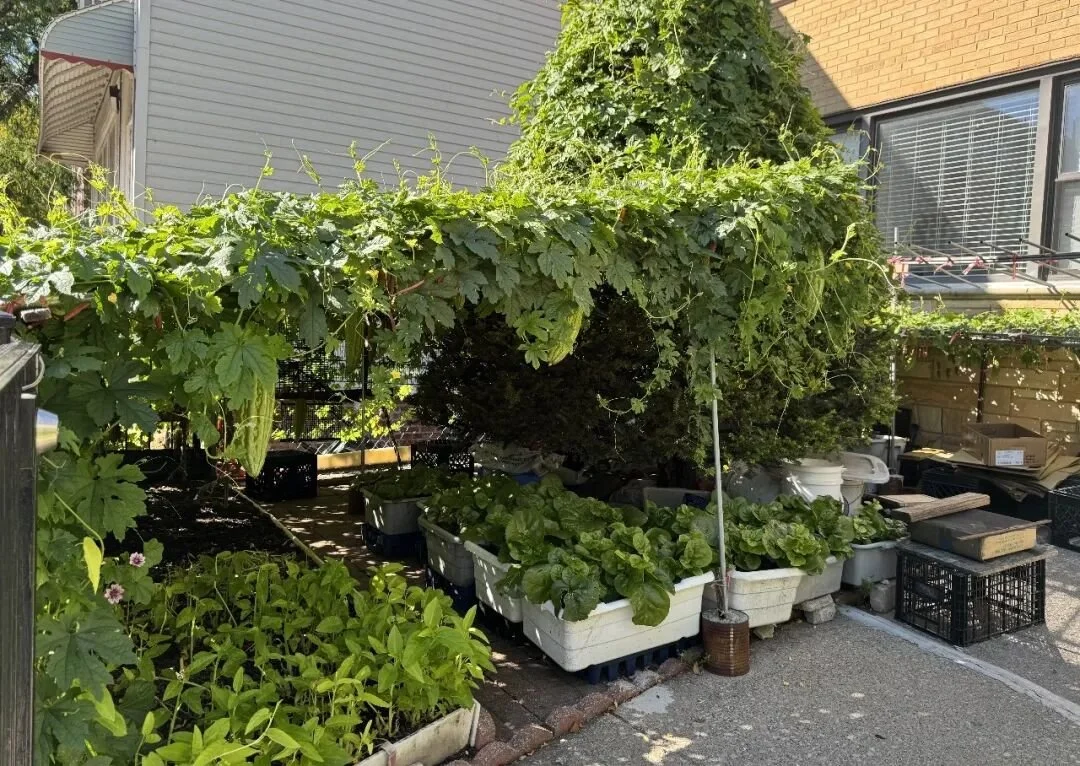
A Chinese resident’s vegetable garden at their home in Chicago’s Chinatown
From Shuxi / Chinatown Spotlight
What is the first thing that comes to your mind when you hear the word “Chinatown”?
For many, “Chinatown” conjures up images of the iconic gate marking the entrance, red pagodas or a variety of restaurants. However, the Chinatown-based Chinese American Museum of Chicago (CAMOC) is showing a rarely seen side of Chinatown, namely its residential “farm-gardens.”
Titled “A Plot of Once’s Own,” this art exhibition explores how many Chinese immigrants living in American cities cultivate vegetable gardens in their backyards. This aspect of Chinatown is often overlooked, replaced by stereotypical images of "pagodas, dragons, and lanterns,” according to the exhibition’s brochure.
"Within this celebration is an invitation to take a closer look at the dimensions of time, space, stuff and relationships woven into Chinese American gardens, with its primordial optimism, that help us understand more of cultural adaptation, neighborhood ecosystems and ourselves," the exhibition's foreword states.
The exhibition will be open to the public until August 29, 2027.
Three years’ worth of field research and conversations
The exhibition’s curators spent nearly three years researching for this showcase. Riley Ren, one of the show’s co-curators, recalled personally visiting the backyards of several families for in-depth interviews. Her fieldwork began with Chinatown residents she knew, and through these introductions, she met more friends and neighbors to converse with. Over time, she even started talking to strangers watering their vegetable gardens.
In these conversations, Ren learned about the types of plants residents grew, their gardening methods, and their harvesting habits. Often, residents would also share their pasts with her without prompting. Moreover, Ren often left those visits with a bag full of fresh produce that residents gave her for free.
The inspiration for this project stemmed from Ren’s reflections on "land" in different cultural contexts: The way land is viewed in the American context is drastically different from her understanding whilst growing up in Beijing, she said.
She described this difference as a contrast between "lawn" and "vegetable garden." In American cities, green spaces are often seen as independently defined private lawns or standardized public spaces; however, in Chicago's Chinese community, residents would connect their adjacent backyards and cultivate them together. In this sense, these vegetable gardens blur the lines between public and private.
“I was thinking that the image of ‘white picket fences and green lawns’, and its association with the ‘American Dream’ and American identity, is at odds with Chinese American gardens,” Ren said. “The way that they’re able to make something out of nothing is super touching to me. So this really is a homage to all those people who are taking care of the land, taking care of each other.”
Because of that, CAMOC staff wanted Chinatown residents to be a part of the exhibition as well.
“We want to have (the) neighbors' involvement, (without) treating them as a subject matter,” Ren said. “This is their house too. We want to be respectful to show their story, but in a non-extractive way.”
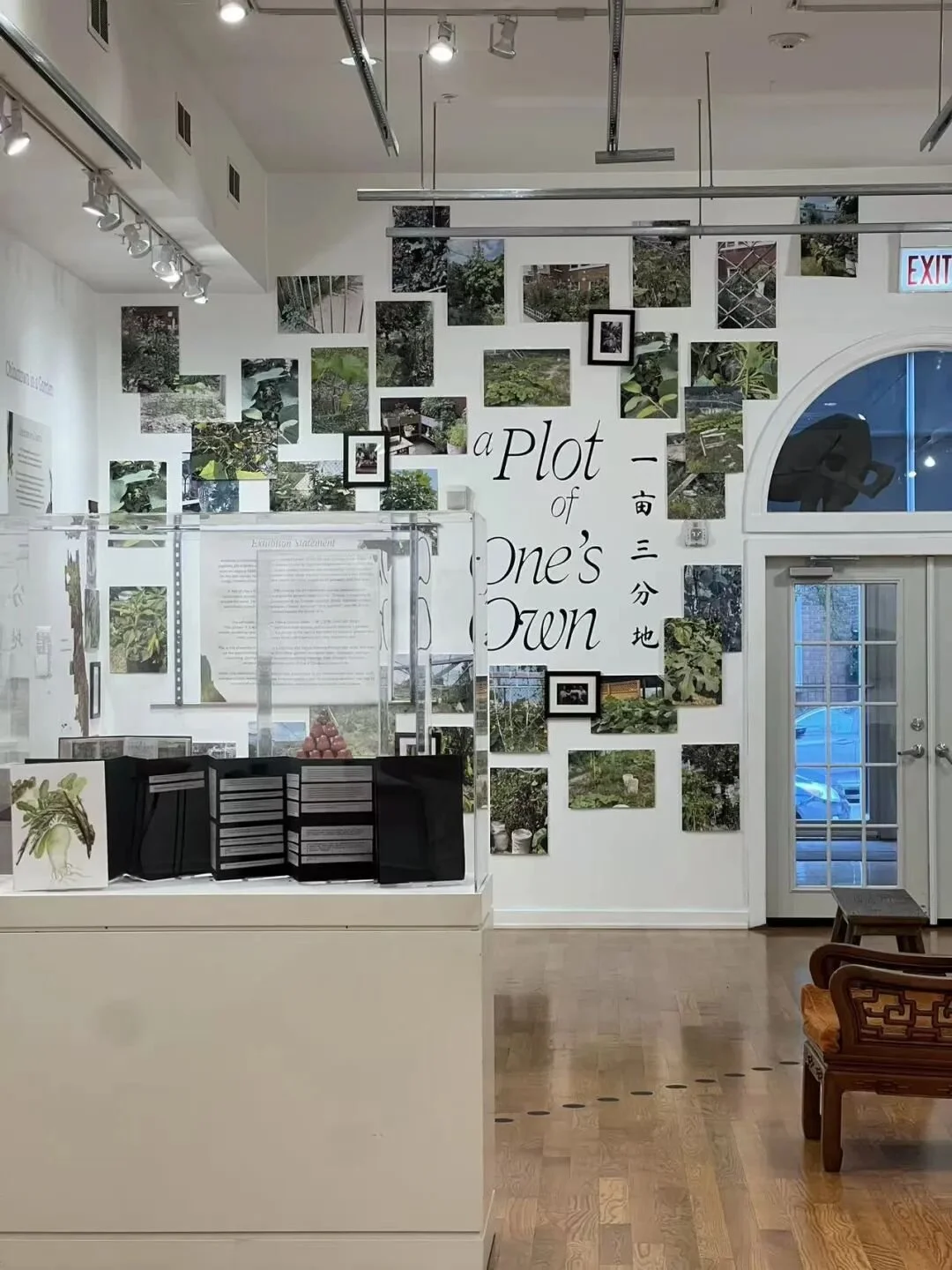
CAMOC’s new exhibition A Plot of One’s Own
From Yudan / Chinatown Spotlight
From Soil Memories to Historical Migration
The exhibition is divided into four parts, each with its own theme. The first part, “Chinatown in a Garden,” presents a slice of life of Chinatown residents who are growing vegetables.
Upon entering the exhibition area, visitors will first see a photo wall covered with close-ups of plants and vegetables, all taken during the curatorial team's visits to backyards. Further in, a wall displays gardening tools, including shovels, hoes, and Kikkoman soy sauce containers repurposed into flowerpots, all donated anonymously by local residents.
The exhibition also features a detailed map showing the distribution of homes and independent vegetable gardens in Chicago, along with a list of the most popular plants. Sik Fi Jiang, a Chicago resident since the 1980s, was one of the residents who participated in conversations with CAMOC staff. The photo wall featured snapshots of his homegrown figs and red beans.
"We came here in '85 and started growing vegetables in '87," Jiang said in Cantonese Chinese at the exhibition’s opening.
Every summer, he would try growing vegetables he has never grown before, a habit stemming from his upbringing in rural southern China, Jiang explained. In his view, agreeing to display one's vegetable garden is also a way of sharing with neighbors.
"Most Chinese people who come here grow vegetables, for their own consumption, organically, which is better for their health. This exhibition can promote the Chinese habit of growing vegetables to the public, allowing non-Chinese communities to learn from it as well,” Jiang said.
The second section, "Shifting Grounds," shifts the focus from farm gardens to the larger historical context. Through historical maps, newspaper clippings, old photographs and commercial advertisements, this area presents Chinatown’s multiple relocations over the years from its initial location in the Loop to eventually settling in the Near South Side. The exhibition points out that behind these relocations lies a "turbulent cycle of alternating divestment and development."
Although Chinatown presents a prosperous picture today, the right of Chinese immigrants to own land in the United States has never been a certainty, Ren said. She listed examples such as the 19th-century Alien Land Act, which restricted Asian property ownership, as well as Chicago's modern "redlining" policies targeting minority communities.
“I just want everyone to understand how hard-won this small piece of land is,” she said.
Reshaping Identity and Belonging to Home
The other half of the exhibition focuses on the diverse works of 10 Chinese-American artists from across the United States, encompassing painting, sculpture, installation and crafts, echoing CAMOC’s field research.
The third section, “Providers,” exhibits agricultural practices brought by early immigrants from the Pearl River Delta of Guangdong, including techniques such as irrigation, land reclamation, grafting and seed saving.
One artwork in this area is a painting standing on metal rods resembling tree roots. The front of the canvas depicts a tree as tall as a nearby telephone pole; the back is an oil painting showing a lush tree growing out of a wire fence.
The artist who created this work, Yi Cynthia Chen, was inspired by her Hakka parents' vegetable garden, she said.
“This work is really about their relationship between nature and man-made forms: How often we exist both in between and through man-made constructs, how we’re able to find our own sense of self and roots beyond that,” Chen told spectators at the exhibition opening.
Huong Ngô, Hong Kong-born and U.S.-based artist, meticulously replicated the circuit boards her parents made while working in an electronics factory. Beside them hangs a small painting that depicts her parents’ winter melons, highlighting the intertwined aspects of labor and leisure.
The exhibition also features works by the late Andy Hoi-Csiu Chan, a renowned third-generation watercolor painter of the Lingnan School. Chan created and taught in Chicago for nearly sixty years, nurturing hundreds of artists, according to the exhibition’s brochure.
In addition to his paintings, the exhibition also showcases several photo albums taken by Chan, documenting the vegetables and plants he grew.
The final section, "Home Making," further explores how farms can serve as a bridge connecting “the home that was” and “the home that has yet to be,” according to the exhibition’s statement.
For example, this section shows artwork by Chicago-based artist Mari Miller, specifically her chromatographs made using local soil, as well as a special type of paper developed with non-toxic materials to prevent mold and promote seed germination. Her works aim to reflect on
the reciprocal relationship between people and the land.
The exhibition’s exploration of land and roots extends beyond Chicago itself. For example, the show includes a replica map documenting California's immigrant-centric agricultural history, annotating instances such as the 1965 Delano grape strike. There is also a bilingual (Chinese and English) papercraft made by Taipei-born artist Yu-Wen Wu. With it, Wu shares her immigrant experiences from shopping in New York's Chinatown to her mother growing potted green onions and cilantro indoors. The exhibition hopes to start a broader dialogue, since this interplay of immigrants and farming is not limited to Chicago, Ren explained.
“It can be so difficult to feel connected to things,” Miller said. “I hope that people, whether they are Chinese or not when they come into this space, can feel a sense of homemaking, placemaking.”