

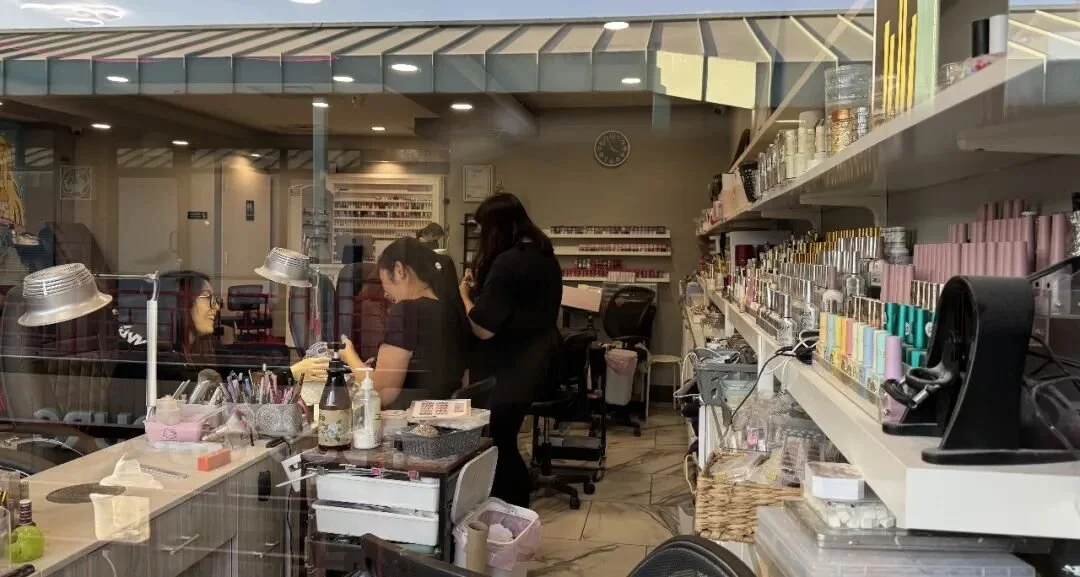
A nail salon in Chicago’s Chinatown, open for business, where nail technicians and customers chat and laugh together.
Credit: Shuxi / Chinatown Spotlight
After 14 years, Illinois nail technicians finally get a licensing exam in Chinese, Korean and Vietnamese.
By Jin Shi
An effort that began 14 years ago
“The nail’s free edge should be filed: A. From the center into the right and left corners. B. From the right side to the left. C. From each side toward the center. D. Quickly back and forth. The answer is…”
Mora Zheng’s voice carried from the classroom as she read the question aloud in Mandarin, followed by a discussion among several students. Zheng was preparing her students for the nail technician licensing exam. Until recently, her students would have had to answer these questions in English on the actual exam. On Oct. 1 of this year, however, Illinois began offering the exam in Chinese, Vietnamese and Korean. Aspiring Chinese-speaking nail technicians can now prepare for the exam in Chinese, without having to memorize unfamiliar English technical terms by rote.
It would be a “seismic” change, Zheng told me in her office.
Zheng owns Elle International Beauty Academy. She has run the school, located in Chinatown Square, since 2011. It is also the only beauty school in Chicago that teaches in Chinese.
Around 2012, Zheng learned from her students that working without a license in the nail industry could mean being treated like “a second-class citizen.” She offered an example: A licensed nail technician could earn $100 a day, while someone without a license might work through the day without time to eat and still earn only $50.
According to Zheng, unlicensed workers often found jobs in salons run by licensed people, starting with basic tasks such as washing customers’ feet and working the cash register. Even when they did the work of a nail technician, they had to do it on the sly for fear of being caught by enforcement officers. Opening a shop of their own was an even more distant dream.
As early as the 1990s, Zheng had passed the cosmetology licensing exam in Chinese in New York. After moving to Chicago, she kept wondering why she could take the exam in Chinese in New York but couldn’t do the same in Chicago. Around 2005, she took an exam in English in Chicago to qualify as a cosmetology instructor.
“It took me a lot of effort to pass that exam. I still remember that the book was 365 pages long, with so many unfamiliar words,” Zheng recalled. “Having taken an exam in English myself, I could really understand what my students were going through.”
Zheng remembered one student, a computer engineer from Dalian who had already studied nail care in China. After coming to the U.S., she could never pass the nail technician exam because of her limited English. In the end, she gave up trying.
What Zheng had experienced herself and what she had seen and heard from her students convinced her to do something to push for a Chinese-language licensing exam.
At an event in Chicago organized by the Defend the Diaoyu Islands movement, a grassroots protest movement supporting China’s claim to sovereignty over the islands, Zheng met Jack Shaw, who worked in real estate, and told him what she hoped to accomplish. He promptly introduced Zheng to his daughter, Anne Shaw, an attorney.
A longtime advocate for the Chinese community, Anne Shaw drew on the relevant legal provisions to write a letter to the governor’s office explaining the community’s request.
“Having that letter helped a great deal,” Zheng said.
The letter was only a start. Zheng still needed to collect signatures from people who supported the effort. Whenever there was a gathering, she brought a sheet of paper and asked people to sign. Her neighbors in Chinatown Square helped rally support. Chinese restaurant owners in Chinatown took some of the flyers back to their restaurants and asked diners to sign. In the end, Zheng collected more than 1,000 signatures.
Around Lunar New Year in January 2014, Illinois finally began offering a Chinese-language cosmetology licensing exam at a test site in Chicago.
“It felt like a big gift from the governor to our Chinese community,” Zheng said with a smile.
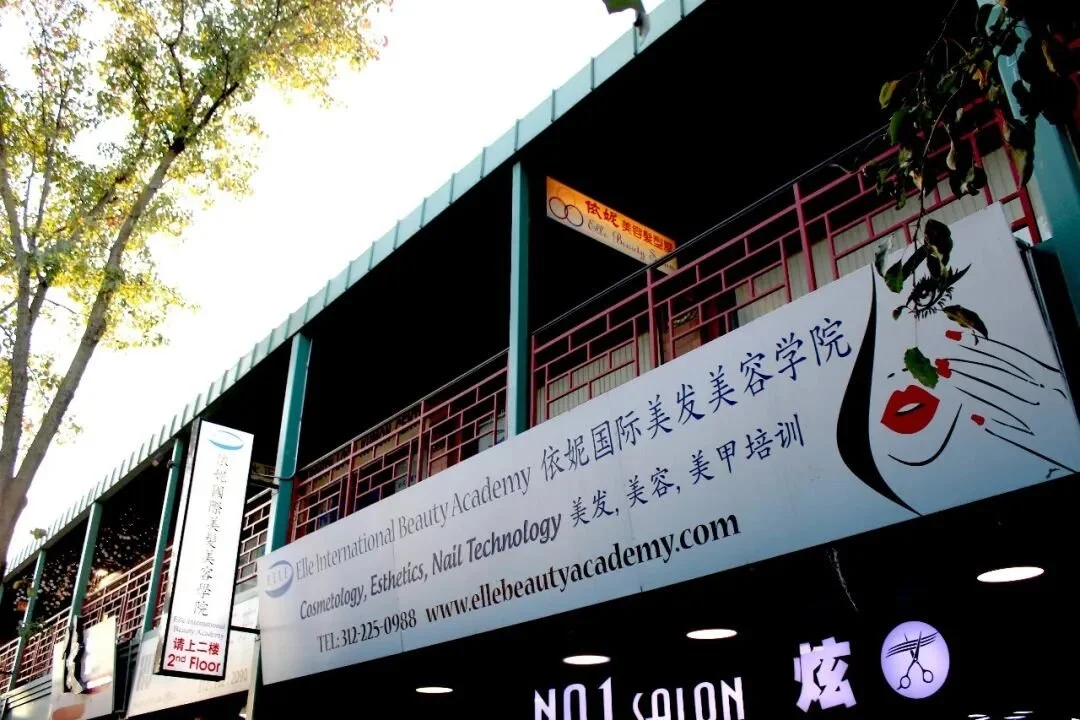
Elle International Beauty Academy, located in Chinatown Square, is the only beauty school in Chicago that offers instruction in Chinese.
Credit: Shuxi / Chinatown Spotlight
One problem remained. The cosmetology license, commonly called the “big license” among Chinese immigrants, covers beauty treatments, hairdressing and nail care and requires 1,500 hours of training. But many immigrants want to work exclusively in nail care. A nail technician license requires only 350 hours of training, making it much less demanding to obtain than the “big license.” For these immigrants, the extra 1,150 hours in class meant giving up 1,150 hours of earnings and paying more for training.
Zheng explained why many Chinese immigrants want to work in the nail care industry.
“One advantage is that the hours aren’t as long as in a restaurant, and it’s easy to get started,” said Zheng, who has worked in the beauty and hairdressing industry for years. “You also need less money to open a nail salon than a restaurant. Your biggest investment might be an electric nail drill, about $500, and you can earn that back quickly.”
Stories abound in the Chinese community of people who made their fortunes doing nails. Zheng shared one with me: A Chinese immigrant owned just one building when he ran a restaurant, but after opening a nail salon, he bought two more. These stories draw more and more newcomers eager to give it a try, all hoping to break into the industry.
In the school’s nail area, Zheng pointed out a collection of nail tips displayed on the windowsill like miniature artworks in a gallery. Zheng pointed to the nail on the far left. Red and gray were its dominant colors. Two bright flowers with red petals and yellow centers adorned diagonally opposite corners of the nail. A long silver river seemed to run between them, with red and black flecks scattered through it like fiery lava.
It was an imaginative design.
Zheng said it was the work of a 24-year-old student, the one she was proudest of. “She remembered everything after seeing it once, and she was so deft with her hands.” After studying at Zheng’s beauty school and earning her license, the young woman opened a nail salon in her home. Then, one evening, the nail supplies stored in her home caught fire. She died in the blaze.
Zheng still grieves the young woman’s death and the loss of the dream the woman had only begun to realize. People think doing nails is a good way to make money, Zheng said, and often overlook the dangers and costs that come with the work. “These toxic materials can harm your health, and they can easily cause fires,” she said.
For many of her students, working in the nail industry is a way of making a better life and putting down roots in a foreign country. The licensing exam, given entirely in English and full of technical terms, was a seemingly small obstacle standing between them and that dream, perhaps the biggest obstacle of all.
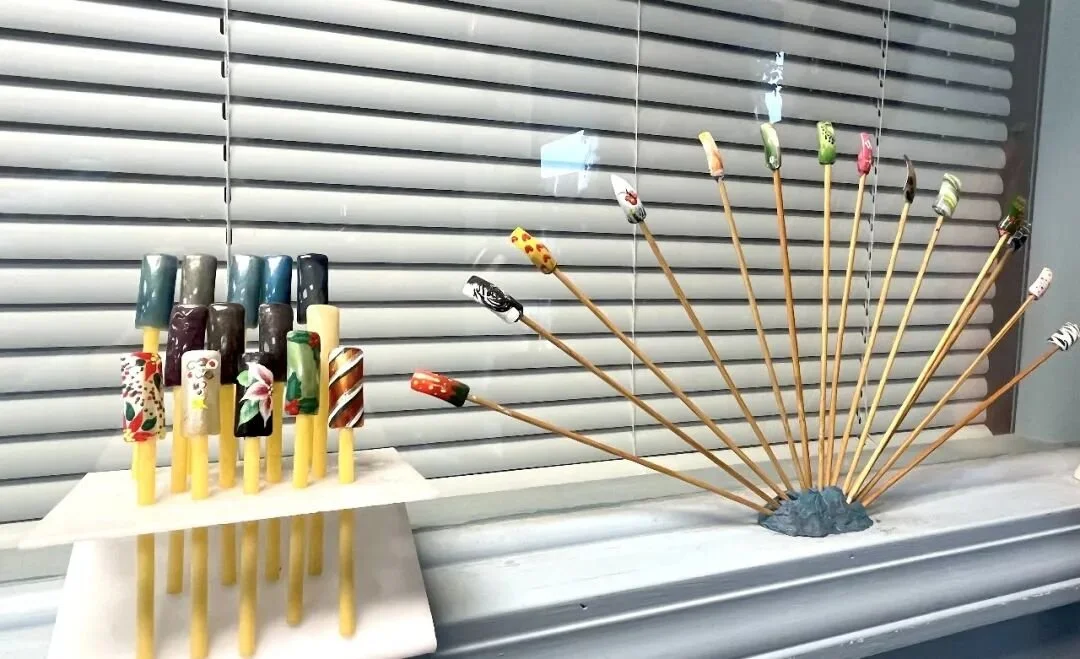
Nail art practice pieces on display at Elle International Beauty Academy.
Credit: Jinshi / Chinatown Spotlight
Summer’s hope
Summer is one of Zheng’s students held back by that language barrier.
Summer enrolled in a program jointly offered by Pui Tak Center and Elle International Beauty Academy after failing her first nail technician licensing exam. Pui Tak Center, a Chinatown nonprofit, received government funding this year to launch the program.
Students can receive about $900 in total reimbursement after completing 50 hours of English and vocational preparation at Pui Tak Center, completing 300 hours of vocational training at Elle, and registering for the licensing exam. Sarah Huang, Pui Tak’s adult education and training manager, calls it a “scholarship” program.
Summer came to the U.S. about eight years ago. She has worked many jobs, including delivering takeout and working in restaurants. She didn’t like those jobs. She said she had worked in clothing for years in China and always loves “beautiful things.” Doing nails seemed like the ideal career for her. Limited English, however, was her biggest barrier, especially when the licensing exam was offered only in English.
Caroline Gao teaches Pui Tak Center’s nail technician licensing preparation course. Gao said Summer was the hardest-working student in the class and always completed all her assignments on time. Even so, Summer failed the exam a second time.
“I was only three questions short,” Summer told me sheepishly. “Because it was all in English, it took me too long to read the questions, and toward the end I started running out of time.”
Summer wore a short black jacket with sequins and her hair in a stylish bob. As she talked about her second failed attempt, she lowered her head, looking a little embarrassed.
Fortunately, Summer received a reimbursement through Pui Tak’s scholarship program. She was the only student to complete the entire process and receive a scholarship since Pui Tak launched the program. “It’s a real help to me. It takes some of the financial pressure off,” she said.
Many Chinese immigrants hoping to become nail technicians may have to take the exam three or four times before they pass. Some may never pass. Every attempt means another fee and hundreds of hours of work. For immigrants whose lives are already precarious, it adds to the burden.
Summer’s son, Chen Le, is also a nail technician. He earned the “big license” in cosmetology, the one for which a Chinese-language exam was introduced in 2014. He now works at a nail salon in downtown Chicago. Mother and son practice on each other, doing each other’s nails. The solid black nails on Chen’s right hand were Summer’s work.
Like his mother, Chen enjoys the creativity of doing nails. In China, he worked nine to five at a bank. He has only recently arrived in the U.S. Once, at the salon where he works, his coworkers got to talking about what they wanted to do in the future. One said, full of hope, “I want to take care of children with disabilities someday and help them grow up.” Another coworker, whose hair had gone largely white, told Chen she was growing it out so that every two years she could donate it to people who had lost their hair during cancer treatment. Those stories stayed with Chen and showed him how many different paths a life could take.
Although Summer has graduated from Gao’s course, she still completes every assignment posted in the class group chat and sends it to Gao for feedback. Summer said she works as a trainee at a nail salon outside Chinatown. Almost none of her customers or coworkers are Chinese, so she speaks English most of the time. Thanks to the Pui Tak Center course, she can now hold basic conversations about nail care. To her, language means independence and a sense of control over her own life. She hopes to keep improving her English.
As for the licensing exam, she hopes to sign up for the Chinese-language test and earn her nail technician license as soon as possible.
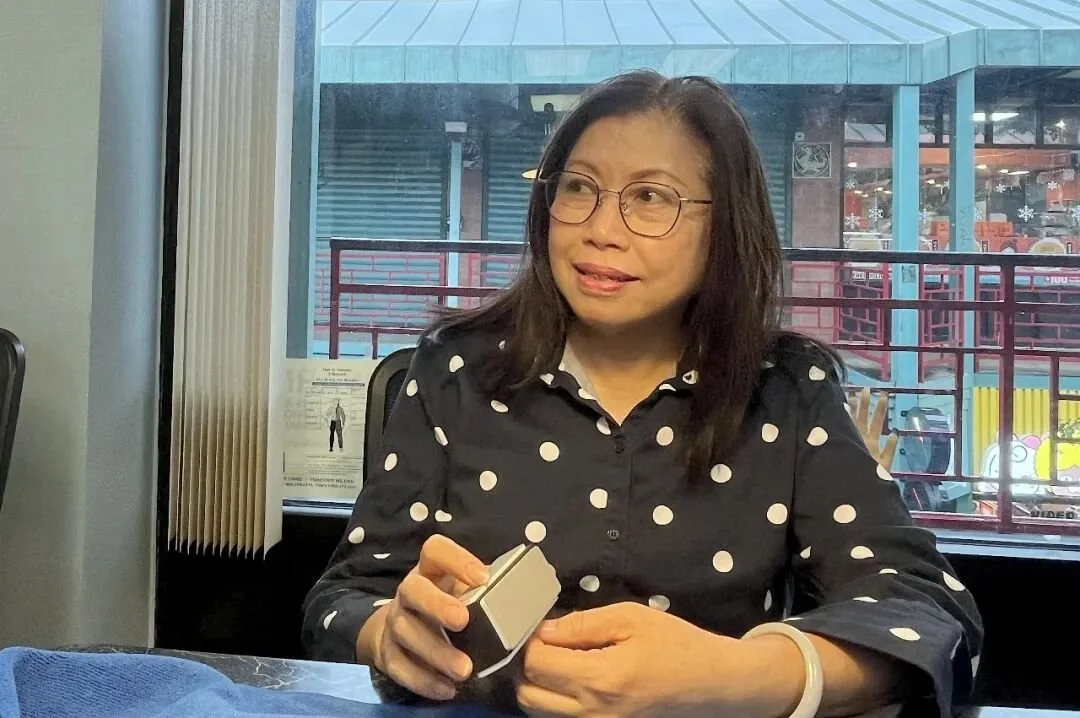
Mora Zheng speaks with the reporter in her office at Chinatown Square about the training courses and her efforts to advocate for Chinese-language examinations.
Credit: Jinshi / Chinatown Spotlight
An English class
On a Monday morning in late September, I sat in on a class in a small room at Pui Tak Center. About 13 students attended that day.
Pui Tak Center holds nail technician licensing preparation courses Monday through Thursday.
Monday is the only day students meet in person. Those sessions usually cover more general English for the workplace and may cover topics unrelated to nail care. Gao said the students generally have a hard time getting time off because they need to work and earn money. Being able to set aside even one day for an in-person class is already a luxury.
Tuesday through Thursday, classes are online. Gao usually goes over material covered on the nail technician exam and walks students through practice questions in both Chinese and English. Huang gathered study materials specifically for the course.
That day’s lesson was on three words, “mission,” “goal” and “plan.” Gao carefully explained the differences and asked the students to make sentences with them. The lesson combined English grammar and vocabulary with a chance for students to think about their own futures.
Many students followed the teacher’s example and said their mission in life was “to become a skilled nail technician and help clients feel confident and beautiful.” A young woman named Liu Xu offered a bold, original answer. Her mission in life was “to travel the world,” and all her other goals were in service of that mission.
Another student, Su Ya, said her long-term goal was “to stay healthy and energetic.”
“My long-term goal is to exercise regularly and maintain a healthy lifestyle,” she continued. “My short-term goal is to build some muscle. My plan for reaching those goals is to go to bed before 11 every night, walk 8,000 steps a day, do some strength and resistance training, eat less artificial sugar and more natural foods.”
When Su finished, the classroom erupted in applause. She already had some command of English and was perhaps the best English speaker in the class.
Su sat next to Chun Mei, an older woman. Chun was 63 and found learning English difficult. She sat attentively through the whole lesson, her phone never distracting her. She said shyly that explaining her mission in English was too difficult for her. She could, however, ask Su the questions in English—Students usually worked in pairs, taking turns asking and answering questions.
The students struggled with the unfamiliar language and worked earnestly at it. It took me back to my high school classroom in China years earlier. When the teacher asked a question, classmates would duck their heads toward their desks to avoid being called on, or look at the person beside them and smile awkwardly. Sometimes there would be a long silence.
Gao occasionally corrected students’ pronunciation or pointed out simple grammatical mistakes—for example, reminding them to add “a” before a singular noun when they left it out. During a break, one woman said quietly to a classmate, “I’ve already forgotten everything we learned last week.” She sounded self-deprecating and a little guilty.
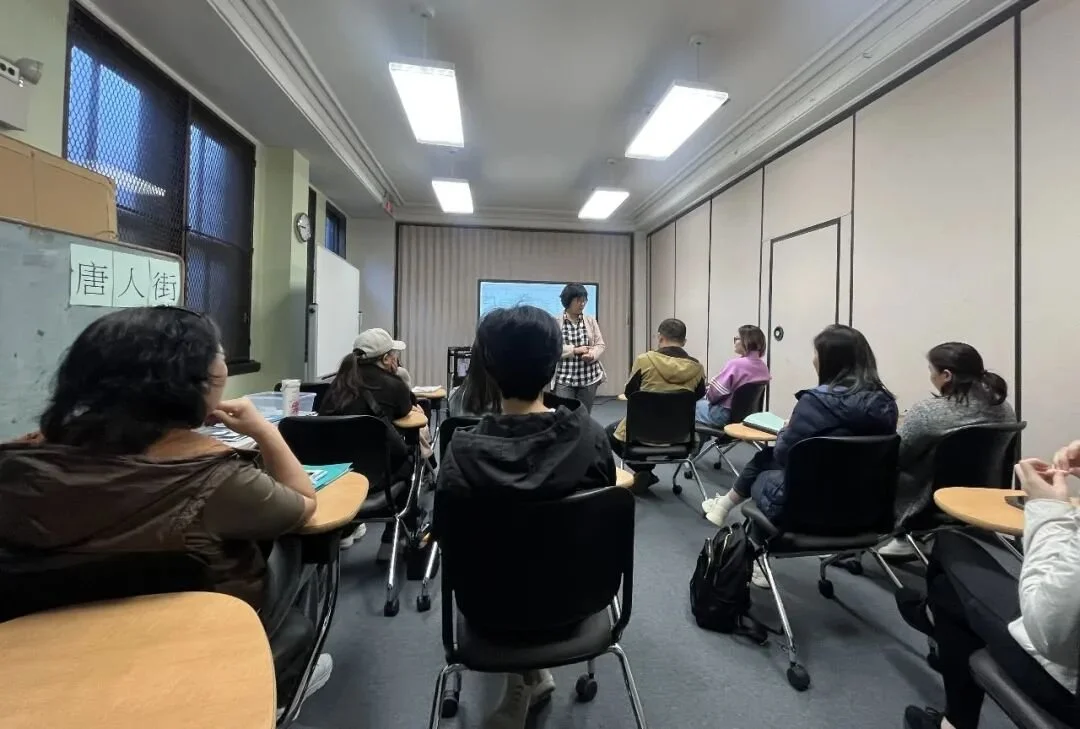
In late September, 13 students were taking the English class at Pui Tak Center.
Credit: Jinshi / Chinatown Spotlight
After class, I sat down with all the students to find out what a Chinese-language exam would mean to them and to their lives.
Chun spoke first. Her daughter owns a nail salon, but without a license, Chun is limited to tasks like working the register. She said she hoped to get licensed so she could take on some of her daughter’s workload.
“I’d taken classes at a training school before. As soon as I got to the exam, my mind went blank. I took it in 2024 and was more than ten questions short. Taking practice tests and taking the actual exam on a computer were completely different,” Chun said, frowning.
Chun said she had noticed that many American customers cared about a nail technician’s credentials. As soon as they walked into a salon, they would ask, “Do you have a license?” She added, “If you don’t have one, they might not feel comfortable letting you do their nails.”
A student named Bai Yu said she currently worked in food service and was taking the class to explore other career opportunities. Several of her classmates were doing the same. Bai felt that if she wanted to go into the nail industry, she would need a license.
“If a dispute arises with a customer while you’re running the business, having a license can protect you. The law can protect you,” Bai said. “Also, without a license, you might earn a little less.”
Two young women in the class said they had already started working in nail salons without licenses. Liu Xu was one of them. She had been doing nails for more than three years and said it was possible to find work without a license, especially in summer when business was good. Having a license would give her much more peace of mind. If enforcement officers caught an unlicensed nail technician, both the technician and the salon owner could be fined.
“When I file my taxes now, I can’t put down nail technician as my occupation. I can only say I sweep floors or do cleaning,” Liu said.
Liu learned about the Chinese-language exam when she called Huang to ask about the nail technician training course. She was thrilled when she heard the news.
“I was going to take it even if it wasn’t available in Chinese. My boss even told me to go buy a fake license,” Liu said. “It’s wonderful that there’s a Chinese-language exam now.”
Some students said many unlicensed workers could find work only in salons run by people they knew. If they were new to the area and had no connections, finding a job could be difficult, especially for older workers, whom employers were even less willing to take on.
Others said many people had done nails for years in China and were good at it, but in the U.S., lacking a license could lead others to question their abilities and leave them vulnerable to mistreatment.
Dennis was the only man in the class. It was hard to picture him as a nail technician. He had a buzz cut and wore a lightweight ocher down jacket. Gao said Dennis was one of the top students in the class and worked especially hard.
Dennis lives in the Chicago suburbs and drives for Uber. Every time he comes to Chinatown for class, he drives nearly an hour. He told me he came “all this way” to give himself and his family a better life. His short-term goal was to get his license. His long-term goal was to have a nail salon of his own.
Removing a small obstacle
It was for Summer and countless people like her that Mora Zheng, Anne Shaw, Sarah Huang and Caroline Gao worked together to remove that small obstacle. One other person was instrumental in getting it done, state Rep. Theresa Mah.
In 2013, Mah was a senior policy adviser in then-Gov. Pat Quinn’s office and his administration’s liaison to Asian American communities. After Zheng and Shaw brought the issue to the governor’s office, Mah took it up.
This September, at the office of the Coalition for a Better Chinese American Community in Chinatown, Mah recalled the sense of urgency she felt when she first heard about the issue.
“I felt this was something that needed to change and that had gone unchanged for too long,” Mah said. “Chinese immigrants had wasted so much time and money (because of this barrier).”
She first approached the Illinois Department of Financial and Professional Regulation (IDFPR). After several meetings, Chinese was added in early 2014 as a language option for the cosmetology licensing exam, the exam for the “big license.”
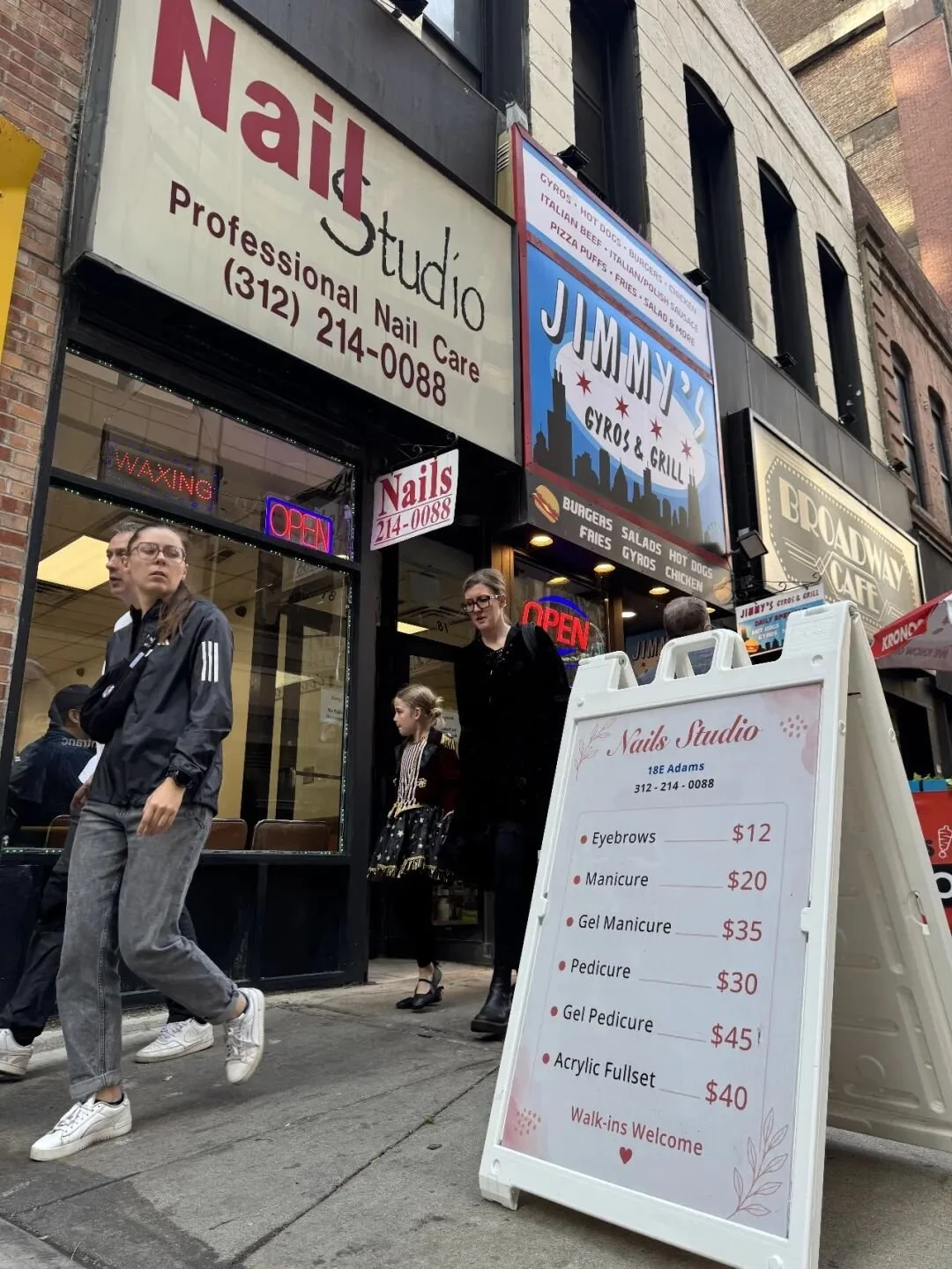
An Asian-owned nail salon in downtown Chicago.
Credit: Shuxi / Chinatown Spotlight
Why did it take so many years to go from the “big license” to the “small license”?
Mah said there were several reasons. One was the change in governors in 2014, when a Republican took over. Even after she was elected to the Illinois House in 2016, she couldn’t move the issue forward. “It didn’t seem to be a priority for the new administration.”
Another reason was that offering exams in Chinese, Korean and Vietnamese took more than translating them word for word. The technical terms had to be accurate, and the different versions had to be comparable in difficulty and meet Illinois licensing requirements. Each language version of the exam also needed a study guide in the same language.
After another change in governors in 2018, Mah took up the issue again in 2019, hoping to finish the work she had had to put aside several years earlier. This time, multilingual exams were added for several of the “small licenses,” including those for nail technicians, barbers and estheticians, in addition to the “big license.”
According to media reports, some nail salon owners voiced opposition when the push for a Chinese-language exam first began. These already-licensed nail technicians believed that if more people could get licensed more easily, Chinatown’s nail industry could become oversaturated, with more technicians than customers needed.
Mah didn't take a position on that view but said that her job is to represent the Chinese American community, especially those who need the most help.
“I like doing things that help people build better lives for their families, and I also want to create more job opportunities for the community,” Mah said.
Zheng said enabling more people to earn their licenses would help them get better jobs and build better lives. She also saw it as a serious safety issue, both for nail technicians themselves and for their customers.
In an announcement posted on the IDFPR website on September 30, Secretary Mario Treto, Jr. said:
“Everyone who has the skills, knowledge and determination to pursue a career should have a fair opportunity to do so, and language should not be an unnecessary barrier to entering the workforce. Expanding language access for these licensing examinations is another way IDFPR is working to make the licensing process more inclusive and accessible, while opening the door to new opportunities for individuals across Illinois.”
At the interviewees’ request, Chen Le, Liu Xu, Su Ya, Chun Mei, Bai Yu and Dennis are pseudonyms.