

At 100 Years Old, This Chinese Grandma’s Favorite Thing to Do is to Ride the CTA Alone to Explore Chicago
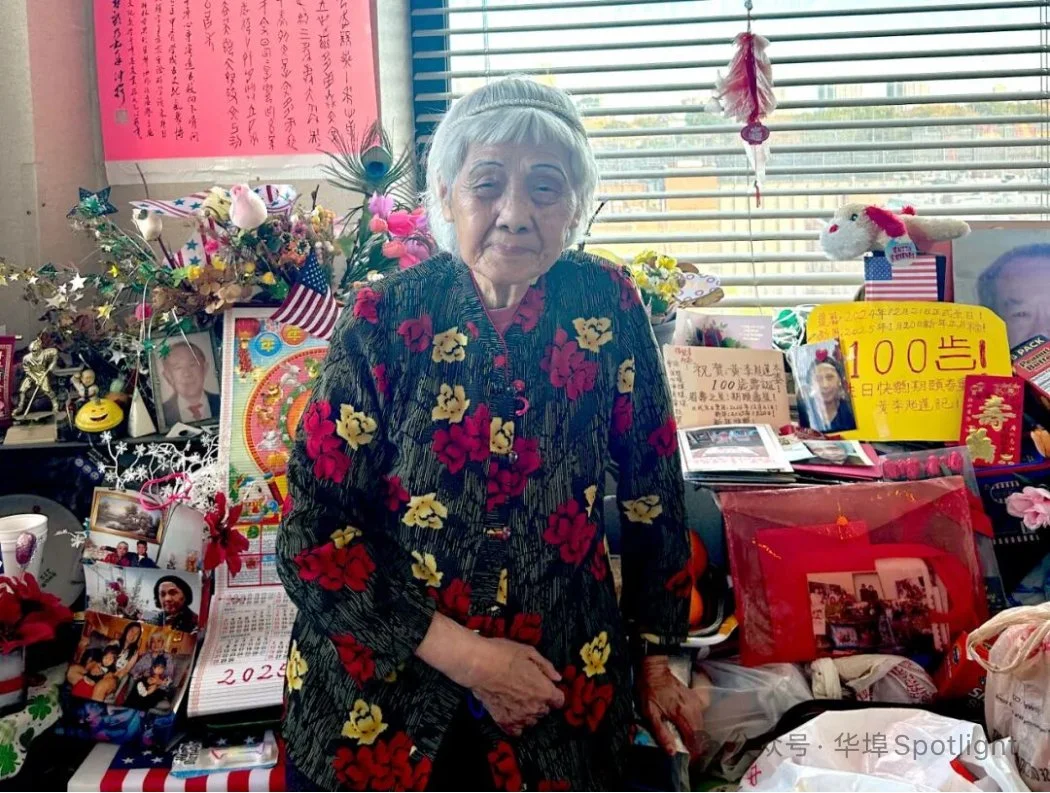
The 100-year-old Madam Huang Li Chaolian in her apartment in the Lincoln Park neighborhood
Xizhi / Chinatown Spotlight
Huang Li Chaolian loves bright colors. She often wears red tops or jackets embroidered with red and yellow flowers, standing out with vibrancy among a crowd of elders dressed mostly in gray and black.
She is often the oldest person in the room. In just two months, she will be celebrating her 101st birthday.
At the end of September this year, I met this centenarian during the Coalition for a Better Chinese American Community (CBCAC)’s fall digital literacy class. She wore a bright red coat embroidered with plum blossoms and sat in the front row, occasionally lowering her head to take notes. When everyone learned that she was over 100 years old—and had taken the subway across half the city by herself from Lincoln Park to Chinatown—they couldn’t help but be amazed.
I met Madam Huang several more times at later events and gradually got to know her. Since retiring, her favorite pastime has been “yau ce ho”.
Note: “游车河” (yau ce ho) literally means “swimming in the river of cars,” in Cantonese. It is a Cantonese term meaning to go for a leisurely ride by car or public transit, usually without a specific destination, just to enjoy the scenery.
“Red Line, buses, even the train—I take them all. Usually I just ride from one end of the line to the other, looking at the scenery along the way. Just by myself, and you don’t need to speak English—you just need a bit of courage. I’m not afraid of getting lost. I just remember which stop to get off at for my home and for Chinatown. Then I make sure to be back at the senior building before 7 p.m. for dinner.”
Recently, I visited this grandma at her home and talked with her about memories from across a century. Just like her clothing and her hobbies, Huang Li Chaolian’s retirement life remains vibrant and colorful, and the world in her eyes is bright and open.
Aging often seems to mean irreversible decline—but Madam Huang, at 100, shows us another possibility.
Event Enthusiast
“This is my turf—just follow me.”
At the end of October, when I visited the senior apartment where Mrs. Huang lives, she was already waiting for me at the door. She stepped out through the front entrance, then led me in through the back door, saying, “You don’t need to check in over there—it’s more convenient.”
Huang’s “turf” is a senior apartment building located in Chicago’s Lincoln Park neighborhood, where she has lived for over ten years. The reason? “It’s spacious enough,” she simply says.
Unlike many Chinese elders in Chicago, Huang did not choose to live in a senior building closer to Chinatown where she is more familiar with and had more acquaintances. Instead, she chose to live in a “gwailo” senior home (Cantonese slang for non-Chinese people). In the entire building, there are only three Chinese grandmas. Huang eats at the same table with them during mealtimes and chats a bit, but otherwise, everyone goes about their own lives.
Despite living on the North Side, Huang is still a frequent visitor to Chinatown. “To see friends, get a meal, and attend calligraphy classes at Chinese American Service League’s (CASL) Senior Center.”
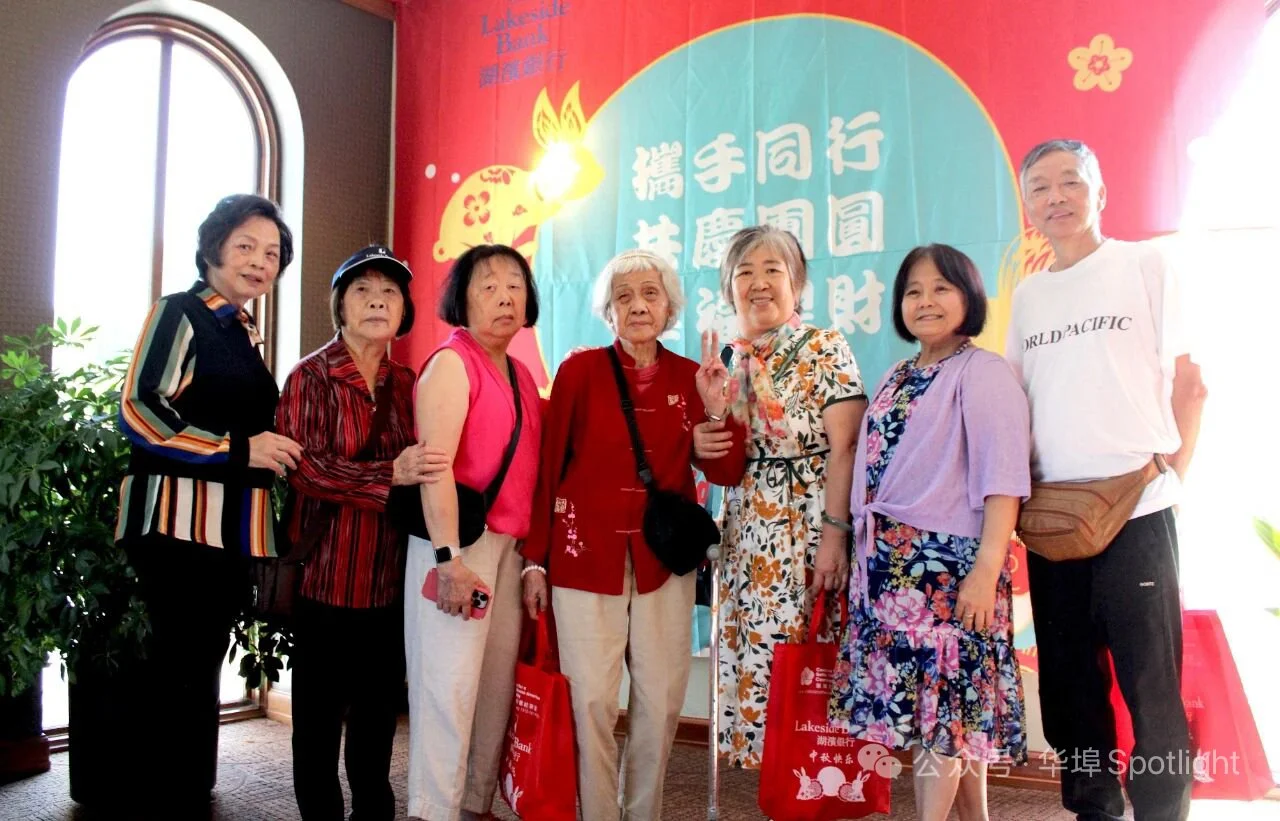
In early October 2025, Huang (center) celebrated the Mid-Autumn Festival in Chinatown with her friends at one of the CBCAC events.
CBCAC/Chinatown Spotlight
At the end of September, she came to one of the CBCAC’s fall digital literacy sessions because a friend invited her. Even though she uses a basic smartphone and can’t fully understand some of the class content, Huang remains interested. A week later, she showed up again for the second session.
This year, she has appeared at many events held in Chinatown—such as the Dragon Boat Race at Ping Tom Park in late June, and the Mid-Autumn Festival celebration at Chinatown Square in early October. She even goes with her friends to early voting sites during election season to exercise her civic rights and cast her vote with solemn pride.
Sometimes, she goes out simply to explore the different neighborhoods of the city.
There is a Route 74 bus stop right below her apartment building, and half a mile to the east is the Red Line station. She often dresses neatly—sometimes with a pearl headband, earrings, or a stars-and-stripes patterned scarf. Looking sharp and poised, she takes her cane, gets on the bus, and sets off on a half-day adventure.
“My mind is still very clear, and I’m flexible and adaptable—so I’m brave enough to go out by myself,” Huang said.
“I’m not someone you can easily push around.”
Mrs. Huang credits her ability to “adapt and improvise” to her years working as a nurse before retirement. “When I first came here, I didn’t understand anything about life in the U.S. But we nurses—our job requires flexibility. So I found ways to adjust to life in America.”
Her ancestral home is Taishan in Guangdong Province, and she once worked as a nurse at the Guangzhou Railway Hospital. Fifty years ago, she followed her younger sister to Chicago and stayed with her after arriving. She sums up her life in the U.S. in one phrase: “I’ve met kind people all along the way.”
The Chinese American Service League (CASL) was the first place she landed after coming to the U.S. She first worked as a cook there. Later, through the introduction of CASL co-founder Bernie Wong, she found a job as a domestic worker. When speaking about Bernie Wong and fellow CASL co-founder, C. W. Chan, Madame Huang expresses deep gratitude.
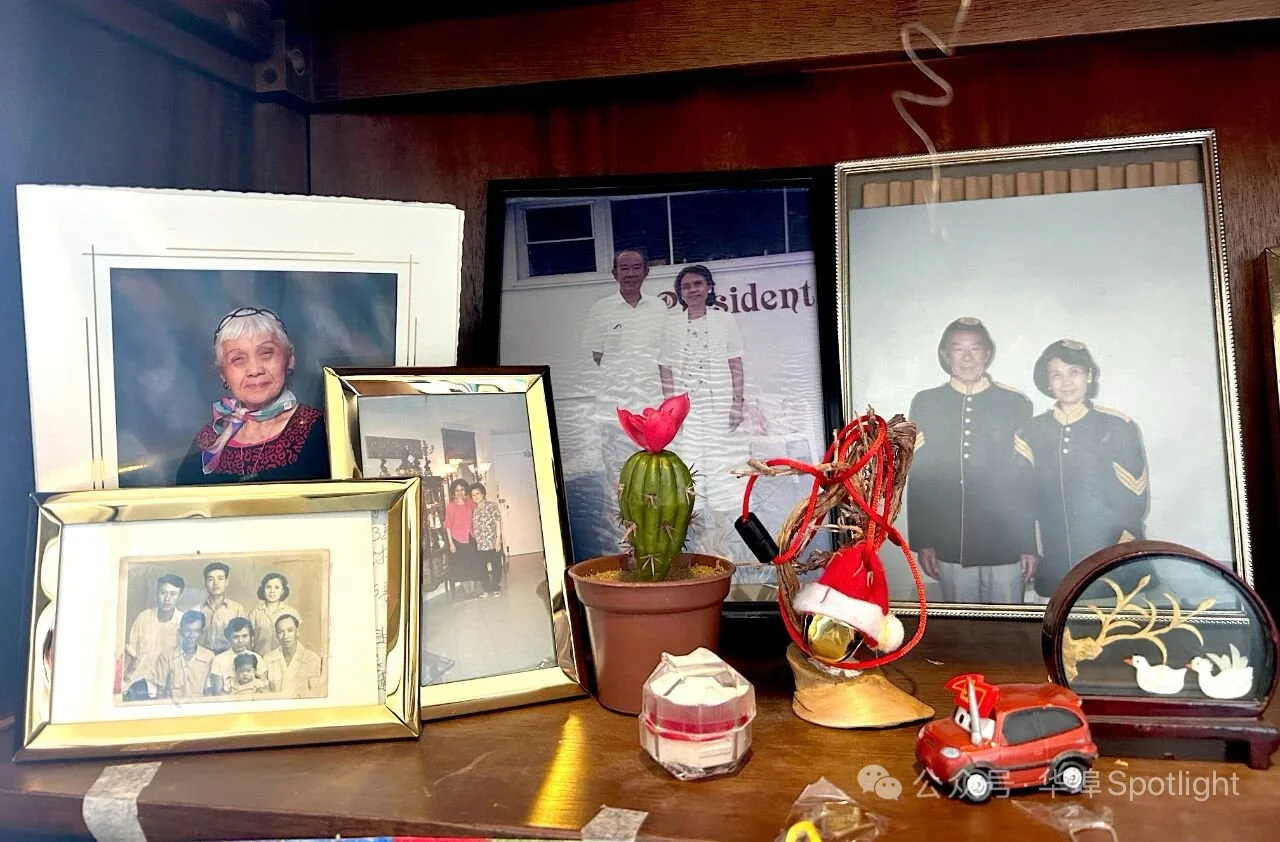
A collection of photographs displayed in Huang Li Chaolian’s home
Xizhi / Chinatown Spotlight
After two years of moving from place to place, Huang met a Taiwanese American nurse at a wedding banquet. Through this connection, she returned to work in the hospital environment she was familiar with. Because she didn’t speak any English at all, the hospital couldn’t offer her a full nurse position—she could only work as a “certified nurse assistant (CNA),” following a Mandarin-speaking nurse.
During her time at the hospital, a few incidents took place. Once, she was unable to lift a weighty patient on her own and repeatedly asked an African American nurse—who was watching TV—to help. The nurse flatly refused. After seeking help from the charge nurse, Huang asked the charge nurse to convey that she wanted a meeting with the hospital manager to voice her concerns. Before the meeting, she asked the charge nurse to write down a few simple sentences for her so she could express her frustration: “Last Friday, I take care a very big man, I tell her help me, she say no.”
During the meeting, the coworker admitted she was wrong and apologized to Huang afterward.
“I wanted them to know that I’m not someone you can bully,” she told me. “After that, when they finished their own tasks, they would sometimes come over and ask if I needed help with anything.”
As she recalled the events, her voice was strong and full of energy. She would switch between imitating the manager’s tone and the coworker’s tone, as if the incident had just happened moments ago.
Aging with Intention
When she’s not going out, Huang spends her time at home reading books and newspapers, or sorting through old belongings. In her apartment, there is a room dedicated entirely to memorabilia—family photos from different decades, calligraphy and collectibles, as well as newspapers, greeting cards, and other items that span more than half a century.
Several handwritten 100th-birthday cards from family and friends are placed prominently by her window. One day in early 2025, staff suddenly asked her to come down to the first floor of the building—only for her to discover that everyone had secretly prepared a surprise celebration for her 100th birthday, complete with a specially ordered cake that read “Happy 100th Birthday.”
That day, she wore a pink silk scarf and posed with a playful peace sign in front of the cake, capturing the moment.
“The cake was huge—I definitely couldn’t finish it myself, so I shared it with everyone,” she said.
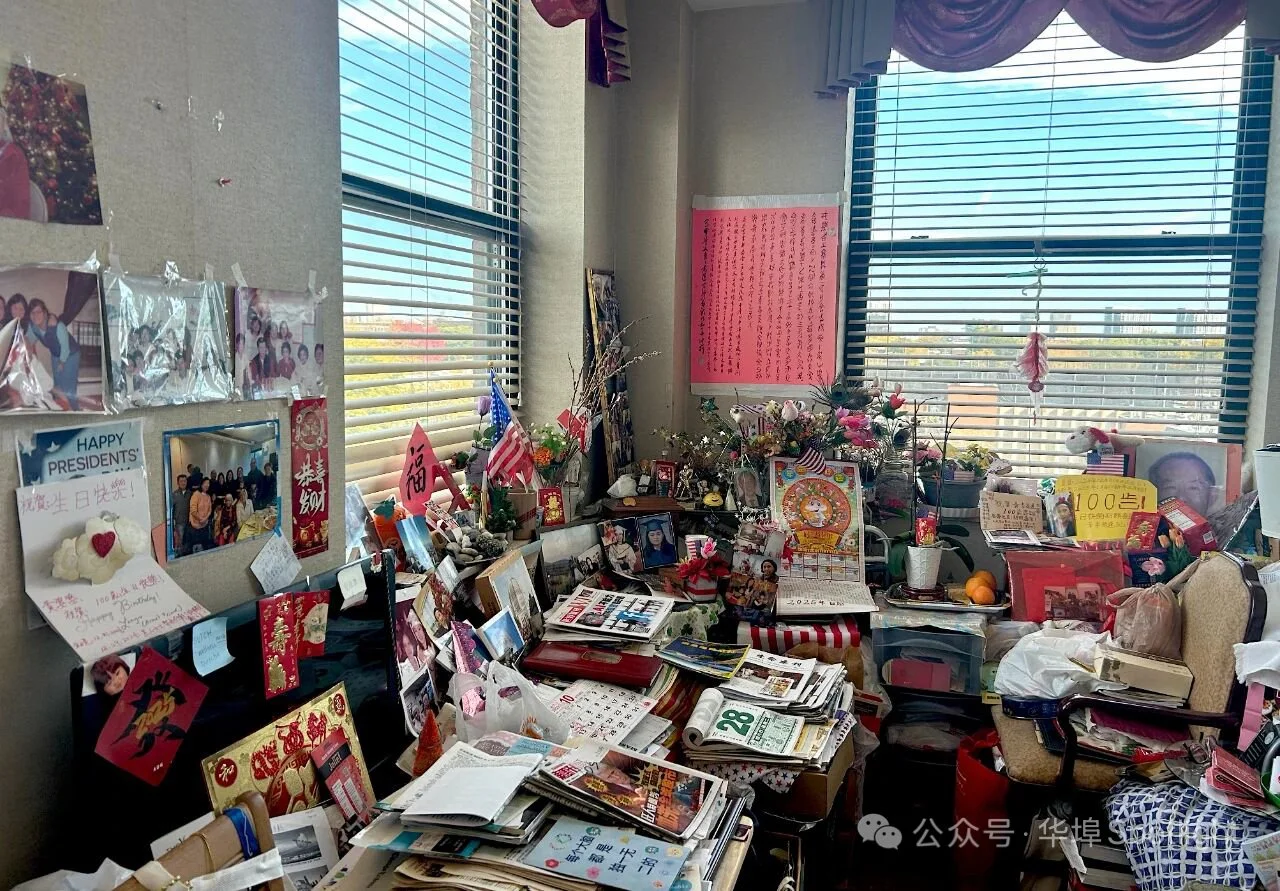
The Collection Room in Huang’s Apartment
Xizhi / Chinatown Spotlight
These stories are also recorded in her diaries. Huang has a habit of keeping a journal, and her thick notebooks are filled with the small details of daily life, sometimes with photos, greeting cards, or even her own drawings tucked between the pages. For example, she writes down the time she wakes up each day, who she talked to on the phone, and what they talked about. She also records her trips—taking the No. 74 bus to the dollar store, spending $14 on a dress for her great-granddaughter, or eating a filling hamburger at McDonald’s.
The colorful objects decorating her apartment, along with those thick journals, embody her attitude towards life. Every person and moment she has encountered—she keeps and treats them with care.
That includes how she treats herself.
She and her husband raised three children, but aside from her youngest daughter, the others have moved to California. Yet unlike many Chinese parents who constantly worry about their children, she believes her kids’ lives should be up to them to choose and decide. She doesn’t stress or interfere.
“If you don’t worry much every day, you live a long life,” Huang said.
Every month, the senior apartment provides her with $120 as “pocket money”. Since she doesn’t have extra living expenses, she often buys small gifts for her grandchildren during her “bus-riding adventures.” As always, she brushes her short silver hair neatly, puts on a headband, and chooses a silk scarf that matches her outfit before heading out.
As for whether her grandchildren actually like the gifts, she says: “I don’t worry about that. I just like giving.”
Author: Xizhi, M.A. in International Relations, University of Chicago
Related Articles
For nearly 40 years, Gourmet Food Inc. has been a part of Chinatown residents’ lives.