

The Women Shaping Chinatown|Caroline Ng: Staying Curious
Editor’s Note: March is recognized annually as Women’s History Month. This year’s theme is “Leading the Change: Women Shaping a Sustainable Future”
In Chicago’s Chinatown, women’s roles are undergoing a profound transformation—from being overlooked to stepping into the spotlight. They are not only the backbone of their families, but also key drivers within community organizations, public affairs, and cultural institutions. Both visibly and behind the scenes, they continue to shape the character and future of the community.
In this month’s special Women’s History Month series by Chinatown Spotlight, we interviewed four female leaders from local nonprofit organizations who are active across different sectors. We document their personal journeys, ways of thinking, and how they understand the meaning of “community” and “womanhood.”
In this issue, we focus on Caroline Ng, Executive Director of the Chinese American Museum of Chicago (CAMOC). From growing up in New York’s Chinatown, to building a career in the restaurant industry, to becoming a curator and cultural worker, her experiences span different social spaces and worlds. Along the way, she continues to ask: Who gets to tell our stories? And how can we better understand one another?
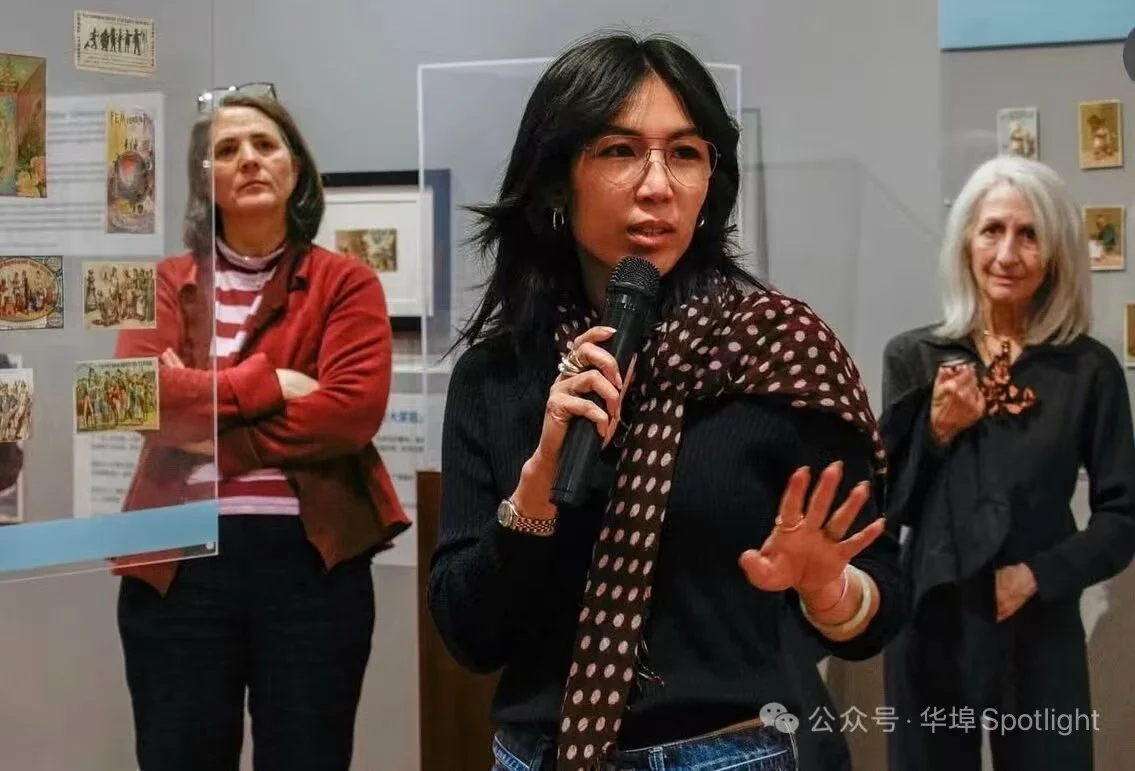
In June 2025, the museum hosted an exhibition on representations of Chinese people in 19th-century American advertising trade cards, where Caroline Ng delivered remarks at the event. Source: CAMOC
Caroline Ng is a curator who has long been active in the fields of art and public culture. In 2024, she became the Executive Director of the Chinese American Museum of Chicago (CAMOC).
Born in the United States and raised in New York’s Chinatown, she spent more than a decade working in the restaurant industry—from the kitchen to management—gaining firsthand experience of urban change and the economic pressures faced by immigrant communities. Around 2016, she returned to academia and the cultural sector, enrolling at the School of the Art Institute of Chicago to pursue a master’s degree in Arts Administration and Policy, and gradually shifted toward curatorial practice. She contributed to projects in the 2019 Chicago Architecture Biennial and has curated a range of interdisciplinary cultural initiatives.
In her view, curation is not just about presenting art, but also a process of “translation”: “You research, you read, you talk with people—and then you reorganize all of that so others can understand and engage with it in different ways.”
She believes this kind of work is essential to a healthy society and democracy, as it creates space for dialogue, allowing people from different backgrounds to better understand one another—and even shift their perspectives.
Her work at the museum has further clarified her sense of purpose. She observes that many visitors to Chinatown remain at the level of “dining and shopping,” with few opportunities to truly learn about the people and stories behind the neighborhood. “They’re curious, and they want to build connections—but they lack the channels.”
Through her work at the museum, she hopes to help shape it into not only a space for presenting history, but also a public platform where people can reflect on identity, belonging, and cultural experience—where both immigrants and non-immigrants can find points of connection to their own lives.
Chinatown Spotlight: In your personal or professional journey, was there a moment when you first realized that being a woman might shape your path or opportunities?
Ng: Honestly, I haven’t really thought about it in those terms. I think for most of us, it’s not something we’re especially conscious of.
And I think that, in itself, is part of the issue—so often, you don’t even realize it’s a factor. Whether it’s gender, bias, or the expectations society places on you, these things are often invisible. And because they’re invisible, we don’t always stop to question them.
I don’t think this applies only to gender—race and class background work in similar ways. It’s easy to accept everything as “normal” without questioning the structures behind it.
For me, there wasn’t a single moment when I became clearly aware of it. In some ways, I’ve also been fortunate to have had many people along the way who cared about me and supported me—people who, within their own capacities, helped and encouraged me.
Chinatown Spotlight: What different perspectives or approaches do you think women may bring when leading teams or serving the community?
Ng: I can really only speak from my own experience. One thing I’ve always tried to do is reflect on the mentors, supervisors, and educators who have had a strong impact on me, and learn from them. I try to think about how to show up “as a whole person,” rather than just occupying a single role.
In terms of communication, I aim to be open and direct. I know that for women, this can sometimes be a double-edged sword—people may interpret it differently, and it can come with its own challenges.
But in my experience, shaped by both my upbringing and cultural environment, I tend to value being as honest as possible and giving others clear information. Of course, that’s not always easy, and it can vary depending on the person and situation.
It’s difficult to make comparisons across genders, but I would say that in my own approach to leadership and decision-making, I’ve been intentional about bringing these experiences into how I lead.
Chinatown Spotlight: In your current work and in the Chinatown community, have you encountered any particular challenges as a female leader? What unique strengths do you think you bring?
Ng: I think one interesting thing is—especially in the nonprofit sector, including in Chinatown—you actually see that many organizations are run by women, much like many families. A lot of things are, in fact, shouldered and maintained by women.
At the same time, this expectation that “women will take care of everything” is often taken for granted. Sometimes we accept it; other times it sparks discussion or even debate, whether at home or at work.
I feel that our generation—or the next—may need to be more conscious of this, to ask ourselves, “Why is it this way?” As women, we indeed play an important role in community-building. We care about relationships between people and pay attention to everyone’s well-being in a team. These relationships need to be valued and protected. I think this attention to relationships also shapes how we make decisions and carry out our work. Many things are interconnected; you can’t separate them. You can’t make changes without understanding or caring about the people involved. For me, that’s the connection between being a woman, being a leader, and being part of a community.
Interestingly, this phenomenon is something everyone “knows,” yet it is rarely discussed or fully acknowledged. I also wonder whether this situation might change in the future.
Chinatown Spotlight: Growing up, was there a woman who had a significant influence on you? What values did she instill in you?
Ng: Yes—those who influenced me the most were my mother and my grandmother. I come from a large family: my father had five sisters, and my mother had four. From the age of four, I lived with my grandmother—even sharing a bed with her. Our relationship was very close and lasted a long time, essentially spanning my entire life. Their impact on me was profound.
One summer, I worked for my mother, who ran a summer school program in New York’s Chinatown. She was actually one of my favorite “bosses.” We often argued at the time because we saw things differently, but it was also part of learning to understand each other. She is an incredibly strong person. I deeply admire her dedication to her work. She cared not only about the children’s learning but also about every aspect of their lives. She thought carefully about how to support their growth in a holistic way.
She often said something that stuck with me: “This is the children’s summer—they shouldn’t just have homework.” She believed learning should be fun, but also meaningful and rigorous. That understanding of learning has had a huge influence on me.
My grandmother taught me to respect the act of doing things well for its own sake. Even when resources were limited, she approached every small task in life with care. She always found time to care for others—I still don’t know how she did it. These seemingly small, everyday actions profoundly shaped how I think about work.
Chinatown Spotlight: In your view, what would a “sustainable Chinatown community” look like? What role can women play in it?
Ng: I feel very proud of the Chinese American community because here, there is a certain level of care and support for women. Women can express their opinions and feel some degree of protection, which isn’t taken for granted in many other places.
In our community, people speak up for women and support them. I think this provides a strong foundation for us to do more.
At the same time, a sustainable community cannot rely solely on women to shoulder everything. What we need is collaboration and mutual respect among everyone. If some people in the team are not heard or valued, the whole system cannot function. I also think that each of us carries some inherent biases, and these need to be recognized and reflected upon.
For me, one important lesson I’ve learned from working in a museum is that by understanding other people’s stories, you can see larger patterns. When these stories aren’t about yourself or your own family, it can actually be easier to observe and understand. I hope we can continue doing this—not just “celebrating women,” but truly understanding the history and the current circumstances. Because this isn’t only about women; it’s about the entire community. We need to involve men and young people, ensure they are heard and invited, and help them engage with these issues as well.
Chinatown Spotlight: If you could say one thing to young women in Chinatown, what would you want them to remember?
Ng: For me, one of the most helpful things is learning to change your mindset while maintaining curiosity—both toward others and toward yourself.
People are constantly changing, but sometimes we feel like we’re not. In reality, different stages of yourself and your future self are always unfolding. I also observe the women around me—including my mother, my grandmother, and women of different ages. They all have their own lives, their own thoughts, and their own stories.
What has always benefited me is this ability to “stay curious.” My mother and grandmother were always learning and evolving. My grandmother, even up until she passed away at 96, remained curious about the world—always asking questions, always wanting to understand others. I think this is a very precious gift and an important practice. It keeps life vibrant and makes it joyful.
Chinatown Spotlight: If you had to describe women in Chinatown with one word, what would it be?
Ng: Fun. I really think they’re all very fun.
Author: Shuxi, Editor-in-charge of Chinatown Spotlight
Related Articles

For nearly 40 years, Gourmet Food Inc. has been a part of Chinatown residents’ lives.