

Women Who Shape Chinatown|Hong Liu: Give back to Community
Editor’s Note: March is recognized annually as Women’s History Month. This year’s theme is “Leading the Change: Women Shaping a Sustainable Future”.
In Chicago’s Chinatown, women’s roles are undergoing a profound transformation—from being overlooked to stepping into the spotlight. They are not only the backbone of their families, but also key drivers within community organizations, public affairs, and cultural institutions. Both in public and behind the scenes, they continue to shape the character and the future of the community.
In this month’s special Women’s History Month series by Chinatown Spotlight, we interviewed four female leaders from local nonprofit organizations that are active across different sectors. We document their personal journeys, ways of thinking, and their understanding of the meaning of “community” and “womanhood.”
In this second issue, we focus on Dr. Hong Liu, Executive Director of the Midwest Asian Health Association (MAHA). From coming to the U.S. as a student from mainland China to founding a nonprofit organization, her career has been closely connected to public health and immigrant services.
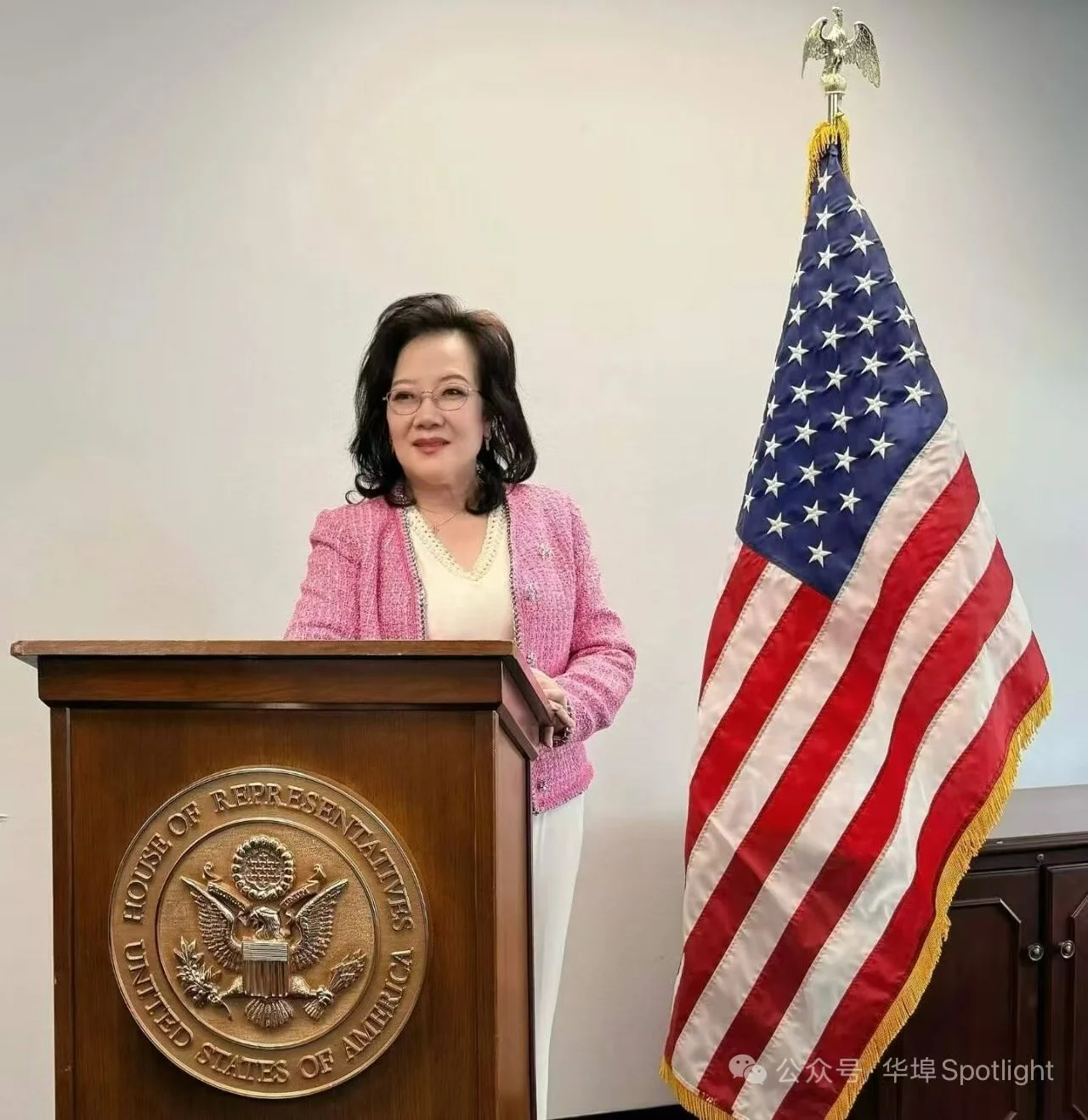
On March 25, Dr. Hong Liu received the 2026 Global Top 20 Outstanding Women Award from Congressman Danny Davis. The photo shows her at the congressional office building. Source: Hong Liu
In the late 1980s, Dr. Hong Liu came to the United States from mainland China as an international student. After earning a PhD in Public Policy Analysis, she began an internship at an immigrant and refugee service organization, where she first engaged with immigrant health services.
"It was this experience that led me into the field of public health," Liu said. "In my work, I saw that many immigrants faced various health challenges, including language barriers, unfamiliarity with the healthcare system, and difficulty accessing resources. These issues made me start paying attention to public health in immigrant communities."
Since then, her career has focused on public health and immigrant communities, gradually building extensive experience. In 2009, Liu founded MAHA in Chicago’s Chinatown to provide health-related services to the Asian community. More than a decade later, MAHA has grown into a sizeable nonprofit with five locations and 32 service programs. In 2025, MAHA served more than 60,000 individuals.
Liu explained that MAHA’s programs are designed around the actual needs of the community. For example, in 2024, they established the first food Pantry in Chinatown. "We noticed that many elders often had to go to other neighborhoods to receive food, which was inconvenient. Now, they can just walk over to the local pantry," she said.
"As Chinese Americans we also pay taxes, and these government resources are funded by our taxes. If we don’t apply for them, we don’t benefit. It’s like a piece of cake; if you don’t claim it, you don’t get a share. So my philosophy is to try to access government resources to serve our Chinese American community," she added.
Currently, MAHA’s services include health education, medical checkups, disease prevention and screening, mental health services, addiction prevention (e.g., gambling), ACA/Obamacare enrollment assistance, family support centers, housing services (such as property tax relief applications), and food distribution programs.
Chinatown Spotlight: In your personal or professional journey, was there a moment when you first realized that being a woman might shape your path or opportunities?
Liu: Mainly it’s about balancing family, work, and personal life. Generally speaking, it’s so easy to lose that balance, especially when serving as executive director. You have to write grant proposals, meet deadlines, and manage projects once they are funded, so the work is overwhelming, and you basically have no life. As a result, it’s easy to overlook your children’s education and family time. On top of that, frequent travel puts you in a constantly unbalanced state.
Fortunately, my husband has been very supportive. But for families with more children, or if the husband also has many responsibilities, it can be very challenging. I consider myself lucky—having family support has been very helpful.
Chinatown Spotlight: What different perspectives or approaches do you think women may bring when leading teams or serving the community?
Liu: I tend to pay more attention to health issues, especially women’s health. For example, women generally live longer than men, and if you look at the dancing groups in the plaza, most of them participants are women. So I pay attention to these trends from a women’s perspective and develop related programs. This includes health issues affecting women in later life, as well as breast cancer prevention and screening programs. It also expands to topics like family and children’s education. We frequently conduct surveys as well, since families are an important foundation for social stability.
In terms of mental health, we also try to provide more care and support for women. Most of the people we serve are women. You could say that, as a woman myself, it’s easier for me to recognize women’s needs. We develop our programs based on these needs. For example, many families come to our programs with mothers bringing their children, so we now offer parent support programs to help them better understand their children’s behavior and build their knowledge and skills.
Chinatown Spotlight: In your current work and in the Chinatown community, have you encountered any particular challenges as a female leader? What unique strengths do you think you bring?
Liu: In Chinatown, the community is still relatively traditional overall, and many traditional associations are male-dominated. In some of these organizations, women did not even have the right to vote in the past.
So within these traditional structures, I think women’s status is still relatively low. That’s why I try to participate more in association activities, such as spring festival galas and similar events. On one hand, it helps me understand their culture and traditions; on the other, it helps strengthen connections. Through socializing and interaction, I hope to better understand their needs so that when we develop programs, they can better reflect those needs. I also hope there can be more regular forms of engagement in the future, such as organizing gatherings to further communication.
Another challenge is civic participation, such as voting and the census. Of course, regardless of gender, participation levels are relatively low across the Chinese-American community as a whole. How to increase people’s sense of engagement and interest is a major challenge.
As for strengths, being a woman can make it easier to empathize with others and identify their needs, and to forge common ground in communication. Women in many Chinatown families play important roles. Many of the participants in our programs are women, and many of them are very active volunteers.
Chinatown Spotlight: Growing up, was there a woman who had a significant influence on you? What values did she instill in you?
Liu: The person who influenced me the most was my mother. She was a teacher, and I come from an educated family—my parents and grandparents were all well-educated.
My mother is very upright and straightforward. I think I inherited her personality—I tend to speak directly and sincerely. As a teacher, she held herself to high standards and was also very kind-hearted. This influenced my decision to work in the nonprofit sector, where I feel a strong sense of responsibility and passion for supporting low-income and vulnerable communities, and helping them overcome various difficulties.
I believe this value of wanting to help others comes largely from my mother’s influence. My mother is now 98 years old. Her health is not very good, and our communication is limited, but she has always been very proud of what I do. When she was in better condition, I would show her photos of the events I attended and the awards I received, and she would be very happy. She has always been very supportive of my work.
Chinatown Spotlight: In your view, what would a “sustainable Chinatown community” look like? What role can women play in it?
Liu: I hope Chinatown can have more nonprofit organizations that work to secure government support. In fact, there are many government resources that can help community development—such as environmental improvements, infrastructure, street safety, and crime prevention. In terms of health, I hope people will place a greater emphasis on health knowledge. At the same time, better healthcare infrastructure is also needed. Right now, many people on Medicaid struggle to access medical resources, especially since there is a shortage of specialists in Chinatown. Political participation is another area that needs attention. If these areas are strengthened, Chinatown will become safer and more prosperous.
Women are, in fact, the core force that drives families. Many things require women’s participation. There are many retired women in Chinatown who are highly capable and experienced. If there were programs to encourage their participation, there would be great potential.
We are already doing some related work, such as encouraging them to take part in community activities. However, resources are still limited, so much of our work focuses on direct services. In terms of community advocacy and leadership development, more resources are needed to train women. Many women are already leaders in their families, and they can also mobilize their families to get involved.
Chinatown Spotlight: If you could say one thing to young women in Chinatown, what would you want them to remember?
Liu: I hope that more well-educated women in the United States will be willing to return to their communities, understand their needs, help their neighbors, and give back.
At present, there are not many leaders working in the non-profit sector within Asian and Chinese communities. Many organizations are also looking for younger successors, but this is a very challenging line of work. So I want to encourage more young people to get involved and realize their self-worth through community service.
Chinatown Spotlight: If you had to describe women in Chinatown with one word, what would it be?
Liu: Hard-working. In immigrant communities, many Chinatown women are incredibly diligent—often serving as the primary breadwinners while also running their households and raising the next generation. This is a defining characteristic of Chinatown women.
Author: Shuxi, Editor-in-charge of Chinatown Spotlight
Related Articles
For nearly 40 years, Gourmet Food Inc. has been a part of Chinatown residents’ lives.