

The Women Shaping Chinatown|Grace Chan McKibben: Believe in Your Capacity and Potential
Editor’s Note: March is recognized annually as Women’s History Month. This year’s theme is “Leading the Change: Women Shaping a Sustainable Future”
In Chicago’s Chinatown, women’s roles are undergoing a profound transformation—from being overlooked to stepping into the spotlight. They are not only the backbone of their families, but also key drivers within community organizations, public affairs, and cultural institutions. Both visibly and behind the scenes, they continue to shape the character and future of the community.
In this month’s special Women’s History Month series by Chinatown Spotlight, we interviewed four female leaders from local nonprofit organizations who are active across different sectors. We document their personal journeys, ways of thinking, and how they understand the meaning of “community” and “womanhood.”
In this issue, we spotlight Grace Chan McKibben, Executive Director of the Coalition for a Better Chinese American Community (CBCAC). Her career began at the University of Chicago, and she went on to serve in a senior leadership role within the Illinois state government. Ultimately, she made the deliberate choice to “return” to her community, bringing the experience she gained in mainstream society back to Chinatown.
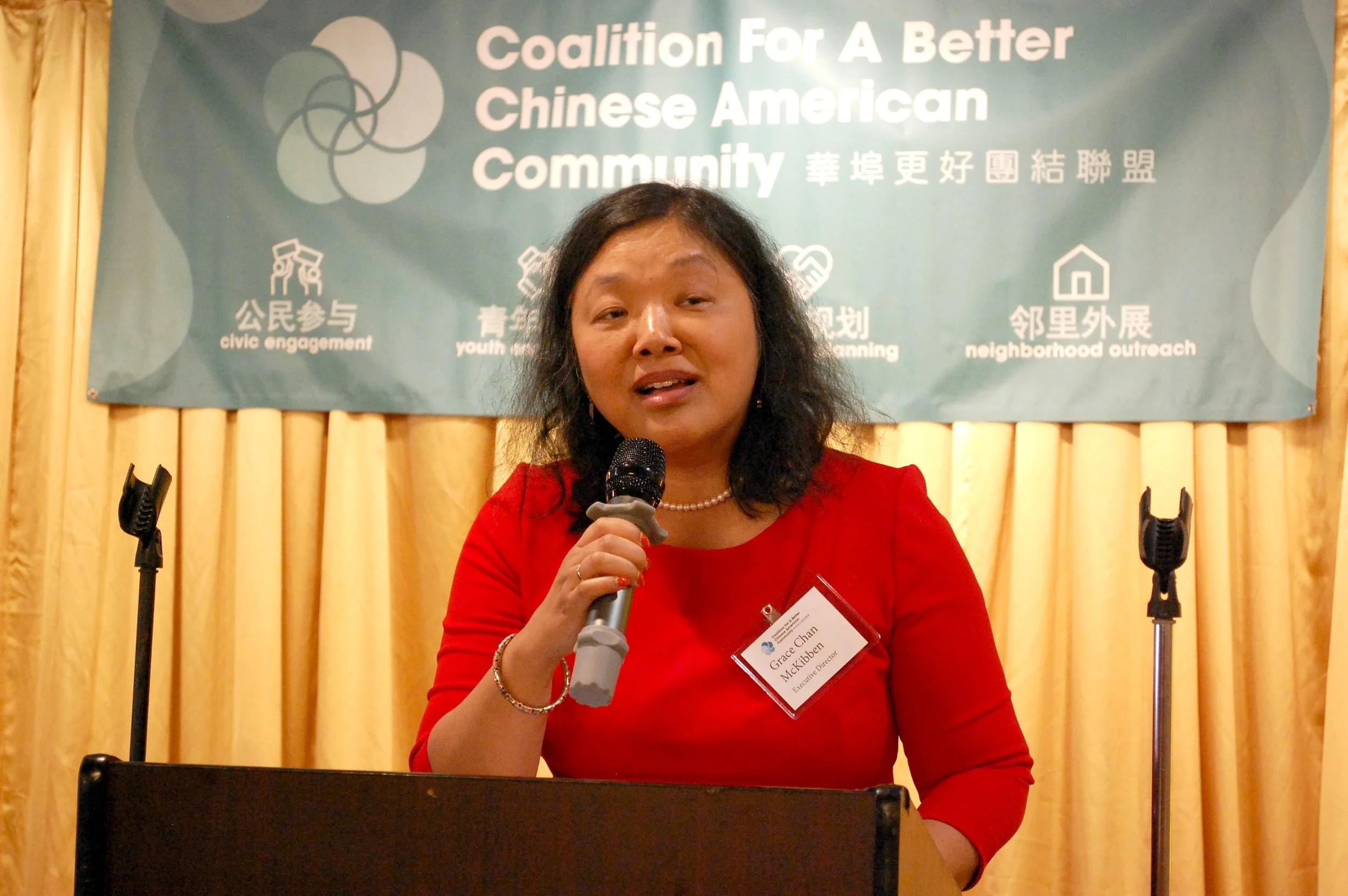
Grace Chan McKibben was born in Hong Kong and attended the prestigious Maryknoll Convent School, known for its English-language instruction. “We had a multiracial youth group at the time, so I was exposed to a diverse, multicultural environment from a very early age,” she said in a 2022 media interview.
As a teenager, she received a scholarship to attend Milton Academy, a preparatory school in Massachusetts. She later enrolled at the University of Chicago in 1986, where she completed both her bachelor’s and master’s degrees, and went on to pursue a PhD in linguistics, focusing on the intersection of language and gender.
She and her African American husband chose to settle long-term in Hyde Park, in part because of its diversity. “Back in the 1990s, there weren’t many places that felt suitable for raising children of Asian and Black heritage,” she explained.
Chan’s career spans academia, university administration, state government, and the private sector—from serving as Associate Dean of Student Affairs at the University of Chicago, to Deputy Director at the Illinois Department of Employment Security (IDES), to working in banking and consulting. These varied experiences led her to recognize the gap between systems and access to resources. “Working in the state government opened my eyes to how difficult it is for ordinary people to access services… There are huge disparities between communities in terms of access and opportunities to be heard. That’s what sparked my interest in social justice.”
During this time, she volunteered in Chinatown, but it was after joining the Chinese American Service League (CASL) in 2009 that she began to focus deeply on nonprofit community work, shifting toward social justice and public advocacy. In her view, this was a conscious “return” to the community—bringing back her experience, networks, and relationships.
In 2019, Chan became Executive Director of the Coalition for a Better Chinese American Community (CBCAC). Founded in 1998 by prominent community leader C. W. Chan, the organization has played a leading role in major community issues such as opposing casino buses, advocating for a new Chinatown library, and supporting the development of Ping Tom Memorial Park. It has also focused on mobilizing Chinese American voters and advancing civic engagement. In 2022, through its advocacy, Chicago saw its first majority-Asian City Council district in over a century.
“In the U.S., organizing doesn’t usually mean organizing institutions—it means organizing people, bringing community residents together so that everyday people can have a voice,” Chan said.
In her view, the core of community work is not just service provision, but ensuring that people from different backgrounds are heard, understood, and able to participate in shared decision-making. Whether through voter registration efforts, policy education, or facilitating dialogue around contested community issues, CBCAC’s role has consistently been to listen, coordinate, and elevate diverse voices—bringing marginalized communities back to the center, bridging longstanding divides, and fostering stronger collaboration.
Chinatown Spotlight: In your personal or professional journey, was there a moment when you first realized that being a woman might shape your path or opportunities?
Chan: I think the biggest challenge has been balancing family and career. Early in my career, I was known for bringing my nursing baby to meetings. I got married young and had children early—we raised four kids together.
When my children were very young, I was quite concerned about whether others would think I couldn’t continue as a professional woman. That was a major source of pressure for me. At the time, I would bring my child to meetings or try to make it so that others wouldn’t “see” that I was caring for a child. For example, I would rush home to pick up my child, arrange for a babysitter, and then return to meetings so people wouldn’t notice that I had to leave early.
It wasn’t necessarily about deliberately hiding it, but more about not wanting others to focus on the fact that you’re a mother with young children. At the same time, you still have to take good care of your kids, so you end up putting in more time—like waking up earlier to get everything ready.
I consider myself relatively fortunate. I was young then, with energy and good health to sustain that kind of lifestyle. My husband and I were both graduate students at the time, so we were able to share the responsibilities of raising our children.
Chinatown Spotlight: What different perspectives or approaches do you think women may bring when leading teams or serving the community?
Chan: I think women—especially those with families—often have to balance many different roles and responsibilities at the same time, and that in itself shapes how they see the world.
In community work, you need to engage with all kinds of people and build relationships, and women often have strengths in this area—for example, being more observant and more attuned to others’ reactions and needs.
Of course, society also places many expectations on women. If you can turn those expectations into strengths—like being detail-oriented or empathetic—that can be an advantage. But when those expectations become limitations—such as assumptions that women are weaker or less capable of making decisions—they can instead become barriers.
Chinatown Spotlight: In your current work and in the Chinatown community, have you encountered any particular challenges as a female leader? What unique strengths do you think you bring?
Chan: In the Chinese American community, sometimes when you’re a woman just starting out, people may not fully trust that you’re capable of doing the work. This isn’t unique to the Chinese community—you see similar dynamics in other communities as well.
For example, when you raise questions or challenge something, if it comes from a man, it’s often seen as professional and worthy of respect. But when it comes from a woman, the reaction can be different—people may feel that you’re challenging them personally. That’s a disadvantage. At the same time, women often learn to navigate different situations more flexibly as they grow up, and that becomes a strength. You become more skilled at approaching problems in different ways.
I think these issues existed in the 1990s, and they haven’t been fully resolved even today. Perhaps school environments are more idealistic, but in the workplace—for example, in terms of support for breastfeeding mothers—these supports are not always truly in place.
Chinatown Spotlight: Growing up, was there a woman who had a significant influence on you? What values did she instill in you?
Chan: There have been many women who influenced me deeply, including my mother. But the person I admire most is my grandmother.
She was an elementary school teacher in mainland China. She did very well academically when she was young, but due to family circumstances, she didn’t have the opportunity to continue on to university. Even so, she always placed great importance on learning and cared deeply about the next generation. I remember she subscribed to an arts magazine called Grand View—not something many children would be interested in—but she noticed that I liked it and would pass it on to me after she finished reading. She paid close attention to what children enjoyed and were good at, and encouraged them to develop their interests. Her students all loved her.
That had a profound impact on me: the importance of paying attention to the next generation, understanding their interests and potential, and offering them support and encouragement.
Chinatown Spotlight: In your view, what would a “sustainable Chinatown community” look like? What role can women play in it?
Chan: A sustainable community must have a next generation that can carry its development forward. As I mentioned earlier, it’s important to pay attention to young people, to nurture them, and to make them want to stay and participate in the community.
At the same time, community development requires planning. Development is not always positive—it can bring environmental issues, impact small businesses, or disrupt the lives of everyday residents. That’s why it’s important to think ahead and plan carefully in order to achieve true sustainability.
As for differences between women and men, I don’t think there are absolute distinctions. But in reality, women are often expected to take care of family and attend to others’ emotions and needs, so they may pay closer attention to details and the human aspect when planning. I don’t believe that “men are inherently one way and women another,” but our upbringing and social conditioning do shape certain differences.
Chinatown Spotlight: If you could say one thing to young women in Chinatown, what would you want them to remember?
Chan: I think the most important thing is to believe in yourself—your abilities and your potential. Many times, society makes you feel that “because I’m a woman, I can’t do certain things,” or that women aren’t suited for certain fields, like science or mathematics. But I believe these are unnecessary limitations. Everyone should pursue their dreams and work toward their own goals and vision.
Chinatown Spotlight: If you had to describe women in Chinatown with one word, what would it be?
Chan: I would choose “resilient.” They are able to adapt across different roles and environments, and handle all kinds of complex situations.
Author: Shuxi, Editor-in-charge of Chinatown Spotlight
Related Articles


For nearly 40 years, Gourmet Food Inc. has been a part of Chinatown residents’ lives.