

The Women Shaping Chinatown|Karen Chiu: Leadership Can Take Many Forms
Editor’s Note: March is recognized annually as Women’s History Month. This year’s theme is “Leading the Change: Women Shaping a Sustainable Future”
In Chicago’s Chinatown, women’s roles are undergoing a profound transformation—from being overlooked to stepping into the spotlight. They are not only the backbone of their families, but also key drivers within community organizations, public affairs, and cultural institutions. Both visibly and behind the scenes, they continue to shape the character and future of the community.
In this month’s special Women’s History Month series by Chinatown Spotlight, we interviewed four female leaders from local nonprofit organizations who are active across different sectors. We document their personal journeys, ways of thinking, and how they understand the meaning of “community” and “womanhood.”
In this issue, we spotlight Karen Chiu, Executive Director of Project: Vision. The organization she founded is one of the largest nonprofits in Chinatown providing after-school tutoring for middle school students.
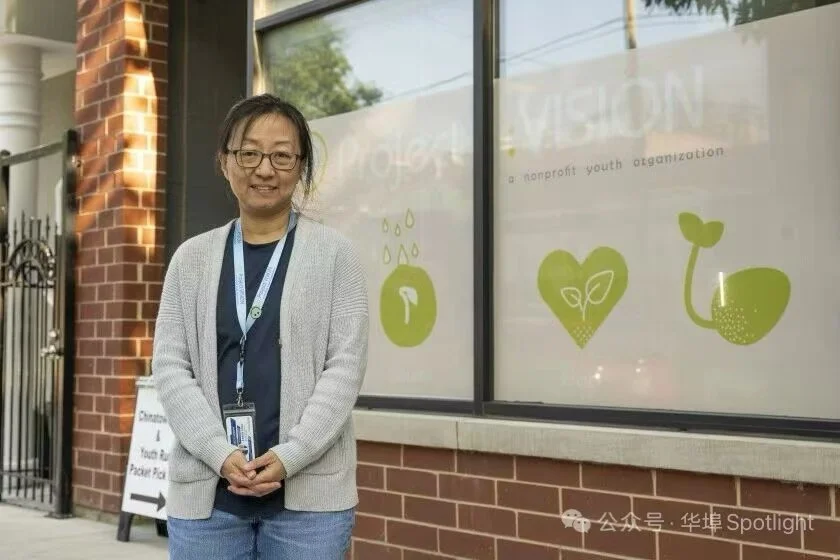
Karen Chiu standing in front of Project: Vision’s office.
Souce: Chicago Sun-Times
Karen Chiu was born and raised in Chicago. Growing up between Chinatown and the suburbs gave her an early understanding of “Asian identity” and “community belonging.” She graduated from the University of Illinois at Urbana-Champaign (UIUC) with a degree in Biochemistry, then pursued medical training at Northwestern University Feinberg School of Medicine, completing her residency in internal medicine and becoming a practicing physician.
During a gap year in medical school, she began deeply engaging in community service, working alongside her mother with after-school programs and youth education initiatives. This experience revealed the gaps in after-school support for Chinatown youth, especially older students, and led her, together with like-minded peers, to co-found the nonprofit Project: Vision (PV) in 2003.
Starting as a volunteer project that borrowed library space and served twenty to thirty students weekly, PV has grown into a comprehensive youth development organization serving hundreds of adolescents. It now offers academic tutoring, career exploration, and civic engagement opportunities. Since 2009, Karen Chiu has served as Executive Director, continuing her medical practice while dedicating increasing energy to the community and creating a space that supports the holistic development of youth.
“We now have over 400 students, from sixth through twelfth grade. PV is also looking to expand further into higher education. On one hand, we still anchor many of our programs in academic support, like tutoring and enrichment courses to prepare for college. On the other hand, we feel it’s crucial to nurture students, especially young people, as whole individuals. That’s why our middle school programs include significant social-emotional learning through STEAM activities, as well as non-academic opportunities in arts, athletics, and civic engagement,” Karen Chiu explained.
According to the organization’s website, 92% of its students come from low-income families, 96% are first-generation immigrant families, and 84% of the students who participate in tutoring become the first in their families to attend college.
Chinatown Spotlight: In your personal or professional journey, was there a moment when you first realized that being a woman might shape your path or opportunities?
Chiu: Most of my professional training has been in the sciences and medicine, fields that are still male-dominated in certain specialties. While no one explicitly barred me from entering these areas, the overall environment was indeed more challenging to navigate and didn’t always align perfectly with my personality, work style, or ways of interacting with others.
Take orthopedic surgery, for example—a highly male-dominated field. During my medical school rotations, I spent time in orthopedics. Everyone was respectful, but being a woman entering what is essentially a “male space” definitely felt different.
I’m not saying I wanted to become an orthopedic surgeon, but if I had pursued that path, the gender dynamics would likely have been a real factor, making the journey more challenging.
Chinatown Spotlight: What different perspectives or approaches do you think women may bring when leading teams or serving the community?
Chiu: I believe women can be just as goal-oriented and results-driven, and they can be very direct as well. At the same time, female leaders often tend to consider multiple perspectives and different contexts, and they are generally more attentive to the well-being of others.
I’m not saying men don’t do this, but overall, women may be more likely to incorporate these factors into their decision-making, which can help create a more inclusive and supportive environment.
Honestly, this is also something I’m still learning. Much of my training comes from the medical field, where leadership styles tend to be more analytical and results-focused, and I’ve naturally adopted that approach. But I’ve gradually realized that leadership has other dimensions—for example, how to cultivate a space that feels more supportive.
Chinatown Spotlight: In your current work and in the Chinatown community, have you encountered any particular challenges as a female leader? What unique strengths do you think you bring?
Chiu: I feel quite fortunate because, within the Chinatown community, I’ve seen many outstanding female leaders. People like Grace Chan and Hong Liu each have their own distinct leadership styles, but all are exceptional. They’ve paved the way for our generation and broken some invisible barriers, making it easier for slightly younger people like me to see that these roles are indeed possible.
Even earlier generations of female community leaders, such as Bernie Wong, have shown us that women can play a significant role in public affairs. I’m not sure how common this is in other communities, but here in Chicago’s Chinatown, we do see many women taking on key roles in nonprofits and public positions.
Chinatown Spotlight: Growing up, was there a woman who had a significant influence on you? What values did she instill in you?
Chiu: I have to mention my mother. Her entire career has been devoted to serving the community, working with children, and education. She taught me how to care for others and how to serve others. Watching her interact with some of the more challenging children—with both firmness and empathy, that “teacher-like” combination of strength and kindness—had a profound impact on me.
In addition, an assistant professor I had in college also influenced me greatly. She was very quiet, but she had a “quiet strength”—she didn’t need to assert herself loudly to prove her capabilities, but demonstrated them through her actions. From her, I learned that you don’t have to be the loudest voice in the room to be a leader.
Chinatown Spotlight: In your view, what would a “sustainable Chinatown community” look like? What role can women play in it?
Chiu: I think it all comes back to the “people” themselves—whether community members feel a sense of belonging, are willing to take responsibility, and care for one another.
The roles women play in families—mothers, grandmothers, sisters—have a profound impact on the next generation. They can instill values as children grow, which is crucial for the future of the community.
At the same time, I hope more young people will continue to stay connected to Chinatown in the future. They may not live here long-term, but at the very least, they carry this place in their hearts and remember where their roots are.
Chinatown Spotlight: If you could say one thing to young women in Chinatown, what would you want them to remember?
Chiu: I believe leadership can take many forms. It doesn’t have to mean standing on a stage giving orders, nor does it have to fit the traditional definition of a “leader.”
What’s more important is finding a way to exert influence that feels comfortable for yourself. Everyone can contribute to the community in their own way.
Chinatown Spotlight: If you had to describe women in Chinatown with one word, what would it be?
Chiu: I would say “resilient.” I often think of my mother, my grandmother, and many immigrant women in the community. They left familiar environments to come here, making countless sacrifices for their families and their futures. They’ve been through so much, yet they persist. That resilience and strength make them truly remarkable.
Author: Shuxi, Editor-in-charge of Chinatown Spotlight
Related Articles

For nearly 40 years, Gourmet Food Inc. has been a part of Chinatown residents’ lives.