

“I am lucky”: Chinese Uber Driver Released to Tell His Tale of ICE Detention
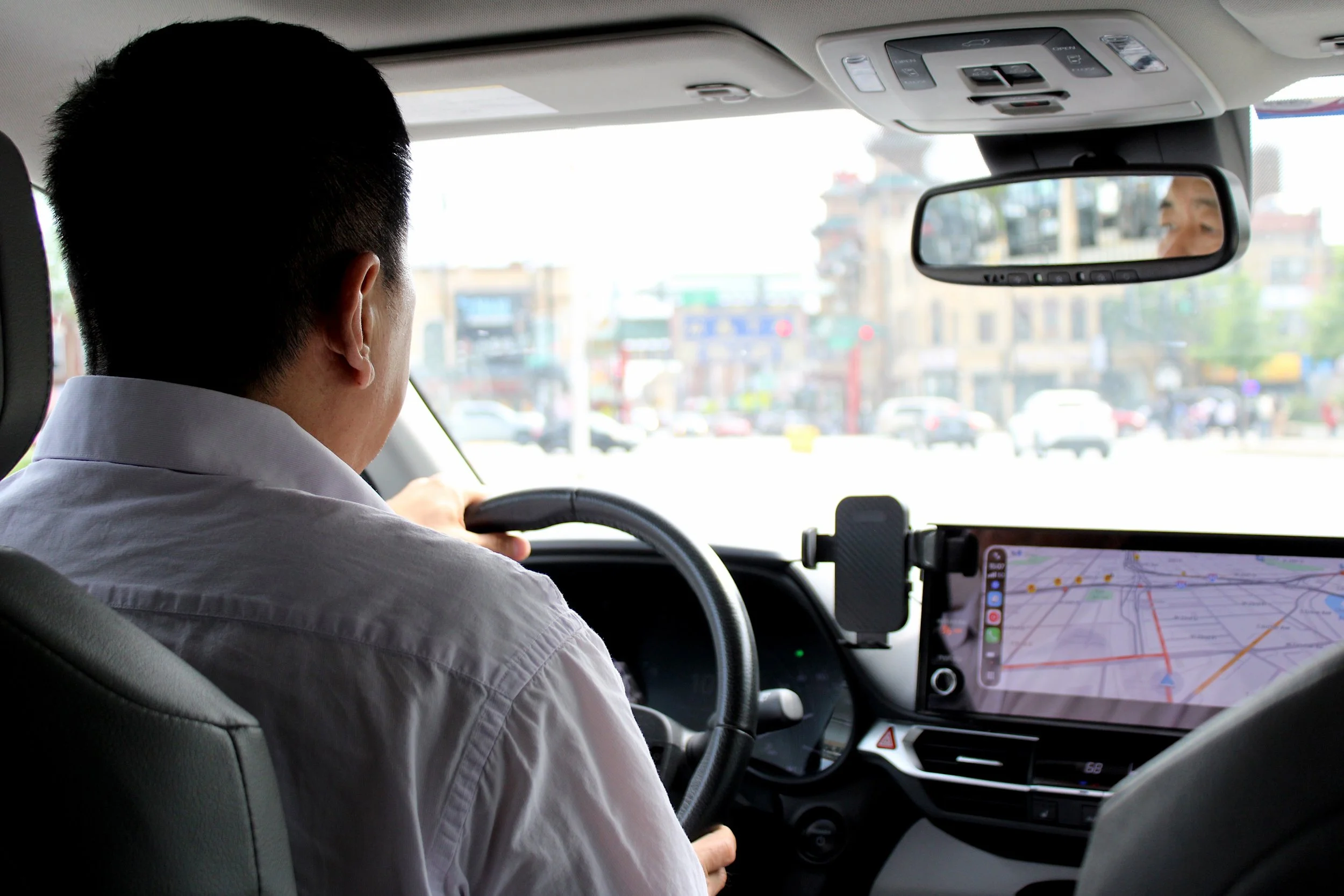
Zhang drives through Chinatown to pick up a regular customer heading to O'Hare International Airport.
Photo credit: Yonggang Xiao/Chinatown Spotlight
"It felt like a nightmare," Zhang recalled thinking to himself, as he finally stepped outside the North Lake Processing Center in Baldwin, Michigan -- after more than two months behind bars.
In the waning days of 2025, Zhang, 56, found himself in a strange town 260 miles from Chicago in ankle-deep snow. The migrant from Shandong Province in northeastern China, stood shivering in the head numbing wind with only a flimsy shirt on. During detention, all his belongings except a cell phone was taken from him.
"I was arrested out of nowhere and released into nowhere," Zhang said, in lingering bewilderment. To this day, U.S. Immigration and Customs Enforcement (ICE) never showed him a judicial warrant for his arrest and he was released on bail without a bond receipt.
Zhang was the very portrait of a diligent, kind-hearted new immigrant striving for his piece of the American dream. Fleeing the draconian lockdowns during Covid-19, he arrived in Chicago in early 2023 on his own to seek political asylum.
Once Zhang secured his Employment Authorization Document (EAD), he toiled tirelessly in restaurant kitchens. As soon as he saved enough to buy a car, he signed up to be an Uber driver. He has received rave reviews that earned him a five-star rating on the ride-sharing app.
Outside work, Zhang has been building his new life stateside with quiet discipline. He’d spend his morning from Monday to Thursday at a community center hunched over English textbooks. On Sundays he worshiping at a church in Chinatown.
One day last October, the sense of security that Zhang had felt proved illusory. He was ambushed by ICE agents in the ride-share lot at O'Hare International Airport and became one of the dozen immigrant drivers swept up in the raid.
Zhang recalled when an ICE agent approached him and asked if he was a green card holder or U.S. citizen. He was handcuffed on the spot even when he could show an EAD as proof of his legal status.
Like many Americans who believe the Trump Administration’s claim that only those with criminal records would be targeted, Zhang was stunned. He was never once cited for traffic violations.
Soon enough, he found himself in a bureaucratic black hole. In his first three days, he shared a cramped, stone-cold holding cell with dozens of equally bewildered detainees in Broadview Processing Center in Broadview, IL, entirely in the dark about what was in store. Then he was driven more than three hours away to North Lake, a sprawling facility operated by the private prison conglomerate GEO Group, bound in shackles.
"We were strip-searched like criminals and asked to change into prison garb. Everyone received only one crappy blanket," Zhang said. The “blanket” was a worn-out padded cover used to wrap bulk items.
"It was so tattered that the slightest movement would shed a cloud of tiny fibers. Because the ventilation in the cells was so poor, these particles drifted in the air and choked our nostrils, making us cough constantly."
As the weeks dragged on, the guards’ initial cordiality hardened into hostility, and the food rations dwindled to one slice of bread and a fistful of beans. "The younger men in their 20s were practically starving," Zhang said. "One day, I watched a young man passing out right on the floor."
According to ICE data reported by Michigan Public Radio, nearly nine out of 10 detainees held at North Lake have never been charged with a criminal offense. To Zhang, the statistic is a damning indictment of an enforcement regime that rounds up immigrants indiscriminately.
"They should at least give me an explanation [for my detention], or deny my asylum claim through proper legal channels before tearing apart my life," Zhang said. "Instead, they just ock people up blindly. Once they realize they got the wrong people, they simply throw them back onto the street with impunity."
Broken by the seemingly endless wait, some of Zhang's cellmates signed voluntary departure agreements just to escape the four walls, even though inking the agreement doesn’t guarantee an immediate release.
“I knew people who had signed those papers months ago but they’re still locked up inside," he said.
In the end, it was the solidarity of his community that came to Zhang’s rescue. He managed to use the facility’s paid phones to alert friends in Chicago, who raised funds to hire an immigration attorney to secure bail for Zhang.
His exit was just as arbitrary as his arrival. Two days before New Year’s Eve, a guard called his name and told him he was free to go—without sending him off with any paperwork.
Now back in the familiar streets of Chicago, Zhang is trying to put his life back together while his asylum case winds through the immigration court system. The trauma lingers: Whenever he passes the parking lot at O’Hare, he still feels a pang of anxiety. Yet, he is more resolute than ever.
"I am lucky; perhaps it was God smiling down on me," Zhang said quietly. Even as he braces himself for his next legal battle, he is determined to live his life as before and do more.
"I have received so much kindness from people over these past few years,” Zhang said. “I want to tell my story, but more than that, I want to go back to my church and my community and serve them in any small way I can."
By Yonggang Xiao
Related Articles

For nearly 40 years, Gourmet Food Inc. has been a part of Chinatown residents’ lives.